泉茂(1922~1995)は、関西の戦後美術を牽引した画家です。
大阪市に生まれた泉は、大阪市立工芸学校(現・大阪府立工芸高等学校)の図案科にて、洋画家の赤松麟作(あかまつりんさく、1878~1953)や、工業デザイナーであり抽象画の先駆者でもある山口正城(やまぐちまさき、1903~1959)から指導を受けました。卒業後は大丸百貨店に勤めますが、在学中も就職後も中之島洋画研究所の夜間部に通うなど、熱心に学びを重ねていました。そんな泉が本格的に画業に専念するようになるのは、終戦後の復員を経てからのことです。
1945年、堺市にアトリエを構えた泉は、春陽会展の落選をきっかけに公募団体のありかたに疑問を抱きます。そこで、自由な創作活動を目指して、1951年に前衛芸術家の瑛九(1911~1960)やグラフィックデザイナーの早川良雄(1917~2009)らとデモクラート美術家協会を結成し、その活動のなかでシュルレアリスムの手法を用いた幻想的な作品を手がけるようになります。また、同会を通じて出会った美術評論家の久保貞次郎(1909~1996)のコレクションに接した際に西洋版画の魅力に気づき、その久保と瑛九の勧めもあってエッチングやリトグラフの制作を始めました。この時期の代表作には、【逃げたスペード】(1955年)や【深夜のセロ弾き】(1957年)のようにトランプや楽器を擬人化したようなもの、【インディアン】(1956年)のように人の顔の部分が大きな花として描かれているものなどが挙げられます。抒情性に満ちたこれらの作品には、戦後の苦境に立たされながらも希望を捨てず、人間の力を信じようとする泉の芸術家としてのありようが窺えます。
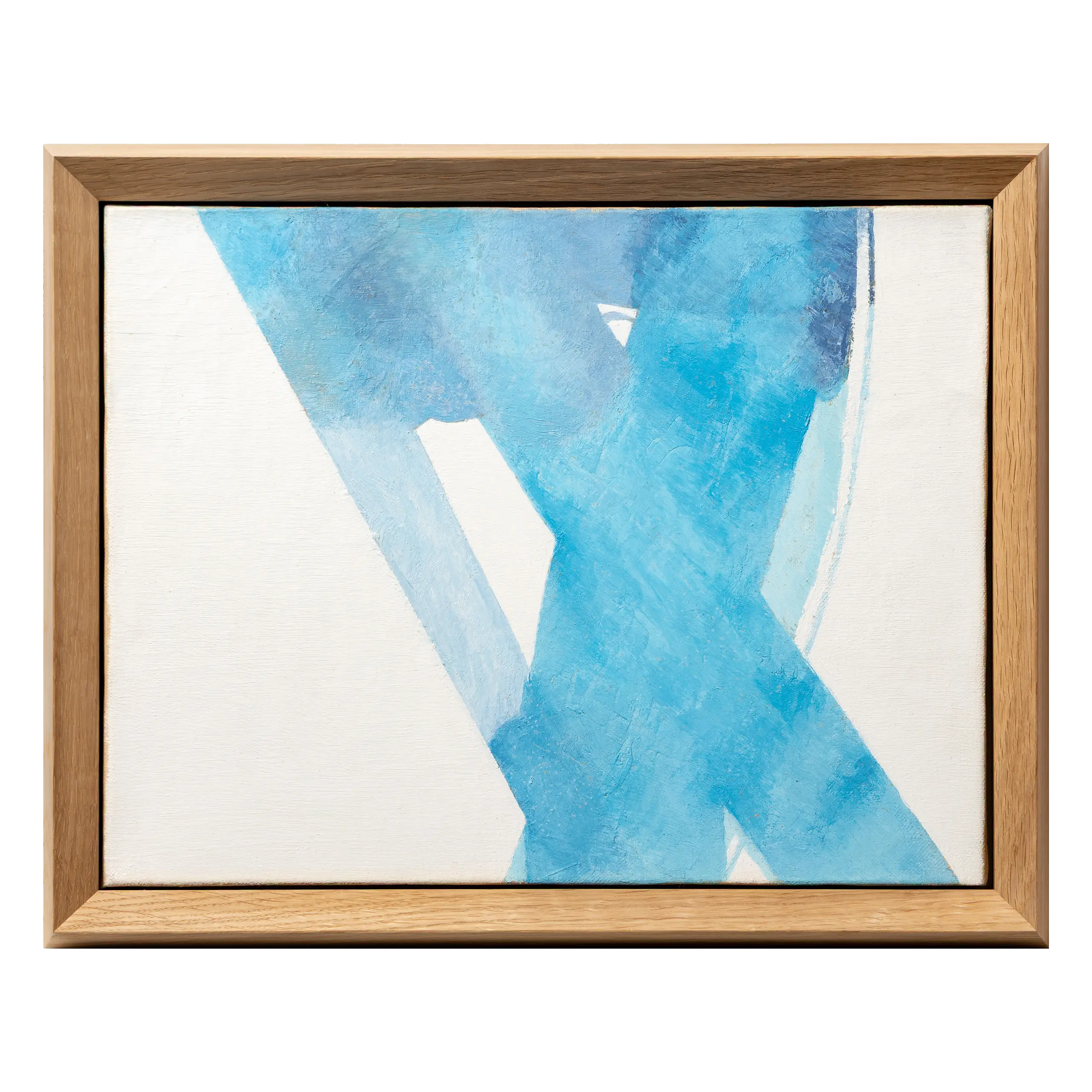
1957年の第1回東京国際版画ビエンナーレ展では新人奨励賞を受賞し、その画才を見出されますが、皮肉にもこの評価がデモクラート美術家協会における理念の対立を生み、同会の解散を促すことになります。1959年、新天地を求めて渡ったニューヨークでは版画から油絵に移行するとともに、以前から扱っていた鳥のモチーフのなかでもクジャクを主な題材とし、羽根の模様が画面を埋めつくす抽象画を制作しました。1963年から1968年にかけて滞在したパリではより抽象度が上がり、青色インクを流すように描いたドローイングから一部を切り取って拡大し、にじみなどを含めた筆跡を白いキャンバスに忠実に写しとるという独創的な方法が編み出されます。この青と白のシリーズは現地で高い評価を受けますが、泉はそこからさらに試行錯誤を重ね、他の色彩も加えながら画面構成や形態を単純化させていきました。
帰国後、大阪芸術大学の教授に就任すると後進の育成に尽力しつつ、学内の大型施設を利用してエアブラシによる吹きつけという新たな技法に挑戦します。この時期から泉の関心は形に移っており、色彩を限定して幾何学的なモチーフをコンパスや定規で描いた一連の作品は、むしろ筆跡を一切残さない無機質な画風へと突き詰められていきました。しかし、1980年代後半に入ると、作風は再び変化を遂げます。アクリル絵の具を使い、円や三角形、菱形など幾何学的な模様を画面の中心に据えつつ、その周囲を色とりどりの雲形定規の形で囲んだ絵は、渡米前後のどの作品とも異なる、晩年の泉が新たに築きあげた世界観でした。その生涯は彼自身が述べたように、「絵を描くことではなく、絵を造る方法を考える」ことに捧げられたと言えるでしょう。
Shigeru Izumi (1922-1995) was a leading figure in the postwar art movement in Japan’s Kansai region.
Born in Osaka, Izumi studied at the Design Department of the Osaka Municipal School of Arts and Crafts (now the Osaka Prefectural School of Arts and Crafts). There, he was taught by Western-style painter Rinsaku Akamatsu (1878-1953) and abstract art pioneer Masaki Yamaguchi (1903-1959), who was also an industrial designer. After graduating, he worked at the Daimaru Department Store, but he was a diligent student throughout his schooling and even after he started his job. He attended night classes at the Nakanoshima Western Painting Institute to hone his skills. It was only after returning from military service at the end of the war that Izumi began to fully devote himself to painting.
In 1945, Izumi established his studio in Sakai City. After a rejection from the Shunyo-kai Exhibition, he became disillusioned with the nature of public art organizations. Seeking more creative freedom, he co-founded the Democrat Artists Association in 1951 with avant-garde artist Eikyu (1911-1960) and graphic designer Yoshio Hayakawa (1917-2009). Through this group, he began creating surrealist-inspired, fantastical works. He also discovered the collection of art critic Sadajiro Kubo (1909-1996), which introduced him to the appeal of Western prints. Encouraged by Kubo and Eikyu, he started producing etchings and lithographs. His representative works from this period include The Escaped Spade (1955) and Midnight Cellist (1957), which anthropomorphize playing cards and musical instruments, as well as Indian (1956), which depicts a human face as a large flower. These lyrical works reflect Izumi’s artistic belief in the power of humanity and his hopefulness despite the hardships of the postwar era.
In 1957, Izumi’s artistic talent was recognized when he won the New Artist Encouragement Award at the 1st Tokyo International Print Biennale. Ironically, this recognition led to ideological conflicts within the Democrat Artists Association, which eventually contributed to its dissolution. In 1959, he moved to New York in search of new horizons, where he shifted his focus from printmaking to oil painting. While he had used bird motifs before, he now focused on peacocks, creating abstract paintings filled with feather patterns. During his stay in Paris from 1963 to 1968, his work became even more abstract. He developed a unique technique of enlarging parts of drawings made with blue ink, faithfully reproducing the brushstrokes, including smudges, on white canvas. This blue and white series was highly acclaimed in Paris, but Izumi continued to experiment, adding other colors and simplifying the composition and form of his paintings.
After returning to Japan, he became a professor at Osaka University of Arts. While dedicated to mentoring the next generation of artists, he also experimented with a new airbrush technique in the university’s large facilities. From this period onward, Izumi’s interest shifted to form. His series of works from this time, which used a limited color palette and drew geometric motifs with a compass and ruler, evolved into an inorganic style that left no trace of brushstrokes. However, his style changed again in the late 1980s. Using acrylic paint, he created works that placed geometric patterns like circles, triangles, and diamonds at the center of the canvas, surrounded by colorful, cloud-shaped forms. These works represented a new worldview that he built in his later years, distinct from any of his previous work. As he himself stated, his life was devoted to “thinking about how to create paintings, rather than simply painting them”.