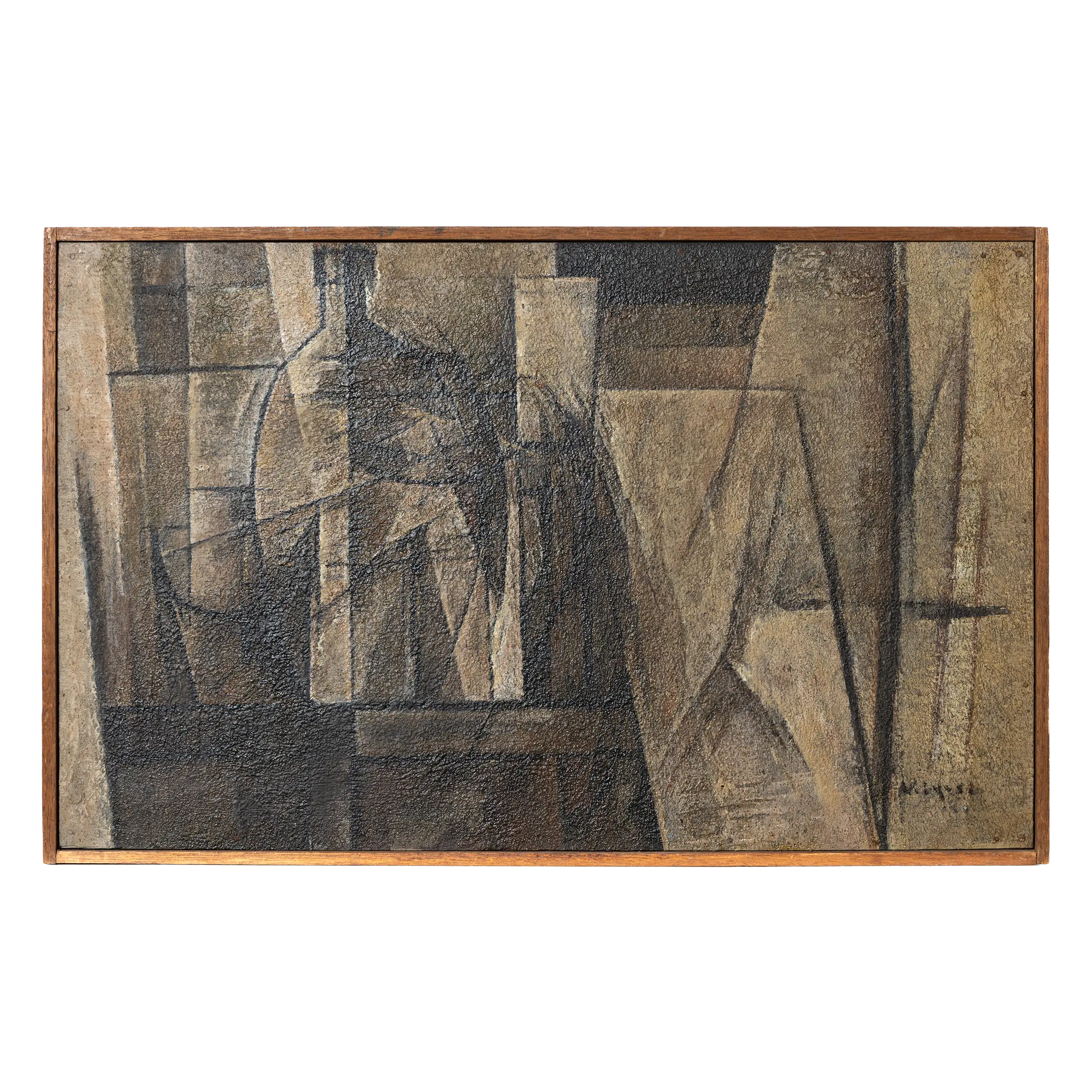
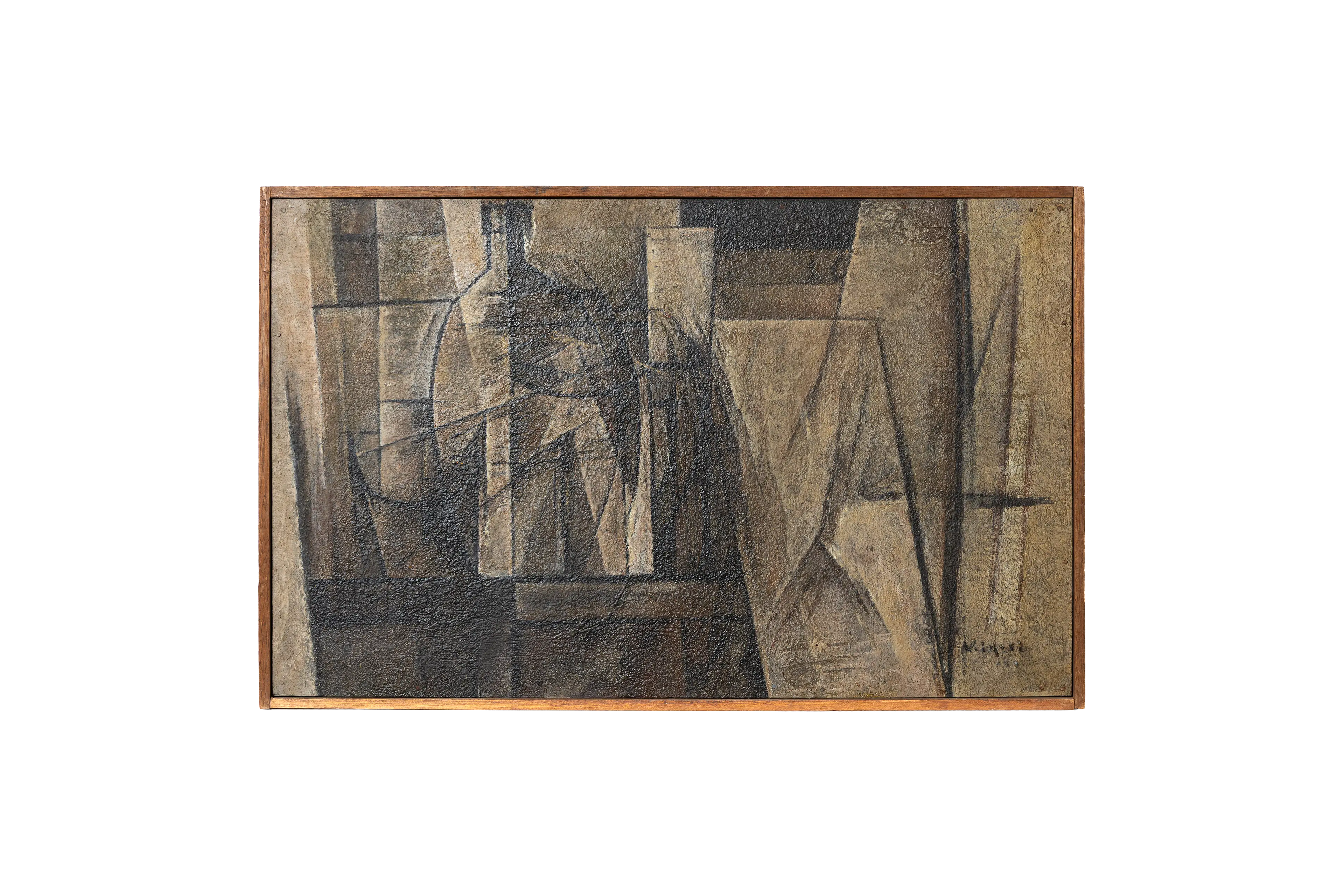
西垣清(1918~1970年前後)は自由美術家協会に所属していた画家であり、同時に山の詩の研究者や登山家としても活躍していた珍しい経歴の持ち主です。
美術関連の雑誌や年鑑にてわずかに残された記録からは、彼が板橋区常盤台に居住していたことのほか、1966年に開催された第28回自由美術展にて、【作品64-A】【作品64-B】の2点を出品していたことなどが確認できます。この作品については、高橋新吉の『すずめ:美術論集 第5』(竹葉屋書店、1964年)にて、「落ちついた色」と短いながらも作品への貴重なコメントがありました。この点は、当店が収蔵している第23回自由美術展の出品作(1959年)の茶色をベースにした色合いとも共通しています。また、こちらはキュビスムを思わせる幾何学的な画面でありながら、温かみを感じさせる雰囲気も注目すべき特徴です。
興味深いのは、美術家として以上に、山の詩の研究者や登山家としての情報が豊富である点です。たとえば、登山をテーマにした月刊誌『山と高原(329)』(朋文堂、1964年2月号)に掲載された、日本山岳会員との対談のなかでは、「木葉童子(対談のなかでは、コノハノドウジともコッパドウジとも読まれています)」という、登山家の間でも非常にマイナーな詩人について語り合っています。なお、西垣がこの詩人を知ったのは、英文学者で登山家の田部重治(たなべじゅうじ・1884~1972)の『峠と高原』(新潮社、1938年)がきっかけだったそうです。さらに、これまた登山家の作家である伊佐九三四郎(いさくみしろう・1932~)の『キリマンジャロの石:辺境の山旅』(現代旅行研究所、1995年)の文中に、西垣の名前が言及されています。マレーシアのキナバル山にて、眠れぬ夜を過ごす中で夢に「自由美術家協会の西垣清画伯」が登場したとのことで、この山へ登ることも元々は西垣が提案したのがきっかけだったそうです。「日本の鉱山会社が現地にあるから、会社の船に乗せてもらってボルネオへ、という遠大な計画を夜を徹して熱っぽく語ったものだったが、その氏も五十歳半ばであの世へ旅立ってしまった」という思い出が語られている貴重な資料です。彼が逝去した年は明確ではありませんが、先述の伊佐九の言葉と、西垣の遺作展が1977年の12月に日本画廊で開催されていることを考慮すると、1970年前後に亡くなっているであろうことが推察されます。
Kiyoshi NISHIGAKI (1918–c. 1970) was a painter affiliated with the Jiyu Bijutsu Kyokai (Free Artists Association) who also pursued an unusual dual career as a researcher of mountain poetry and as a mountaineer.
Sparse records in art magazines and yearbooks confirm that he lived in Tokiwadai, Itabashi Ward, and that he showed two works, "Work 64-A" and "Work 64-B", at the 28th Jiyu Bijutsu Exhibition in 1966. Shinkichi TAKAHASHI’s Suzume: Collected Writings on Art, Vol. 5 (Chikuyokuya Shoten, 1964) offers a brief but valuable comment on these works, describing their “settled color.” That quality also aligns with a work from the 23rd Jiyu Bijutsu Exhibition (1959) in this gallery’s collection, which is built on brown tones. The painting further stands out for its geometric composition, reminiscent of Cubism, combined with an atmosphere that still feels warm.
What is especially striking is how much more documentation survives of Nishigaki as a researcher of mountain poetry and as a mountaineer than as a visual artist. In a dialogue with members of the Japanese Alpine Club published in the February 1964 issue of the monthly magazine Mountains and Highlands (329) (Homon-do), for example, he discusses the very obscure poet Konoha no Doji (read in the conversation as either Konohano Doji or Koppa Doji). According to the account, Nishigaki first learned of this poet through Passes and Highlands (Shinchosha, 1938) by Juji TANABE (1884–1972), a scholar of English literature who was also a mountaineer. Nishigaki’s name also appears in Stones of Kilimanjaro: Travels in Border Mountains (Gendai Travel Research Institute, 1995) by Kumishiro ISA (1932–), another writer and mountaineer. On a sleepless night on Mount Kinabalu in Malaysia, Isa dreamed of “Master painter Kiyoshi Nishigaki of the Jiyu Bijutsu Kyokai,” and the account states that the idea of climbing this mountain had originally been Nishigaki’s proposal. Isa recalls how Nishigaki once spent an entire night passionately outlining an ambitious plan to reach Borneo on a ship arranged through a Japanese mining company with a local presence, only for Nishigaki to pass away in his mid-fifties. The year of his death is not firmly established, but taken together with Isa’s remarks and the memorial exhibition of Nishigaki’s remaining work held at Nihon Gallery in December 1977, his death may be placed around 1970.