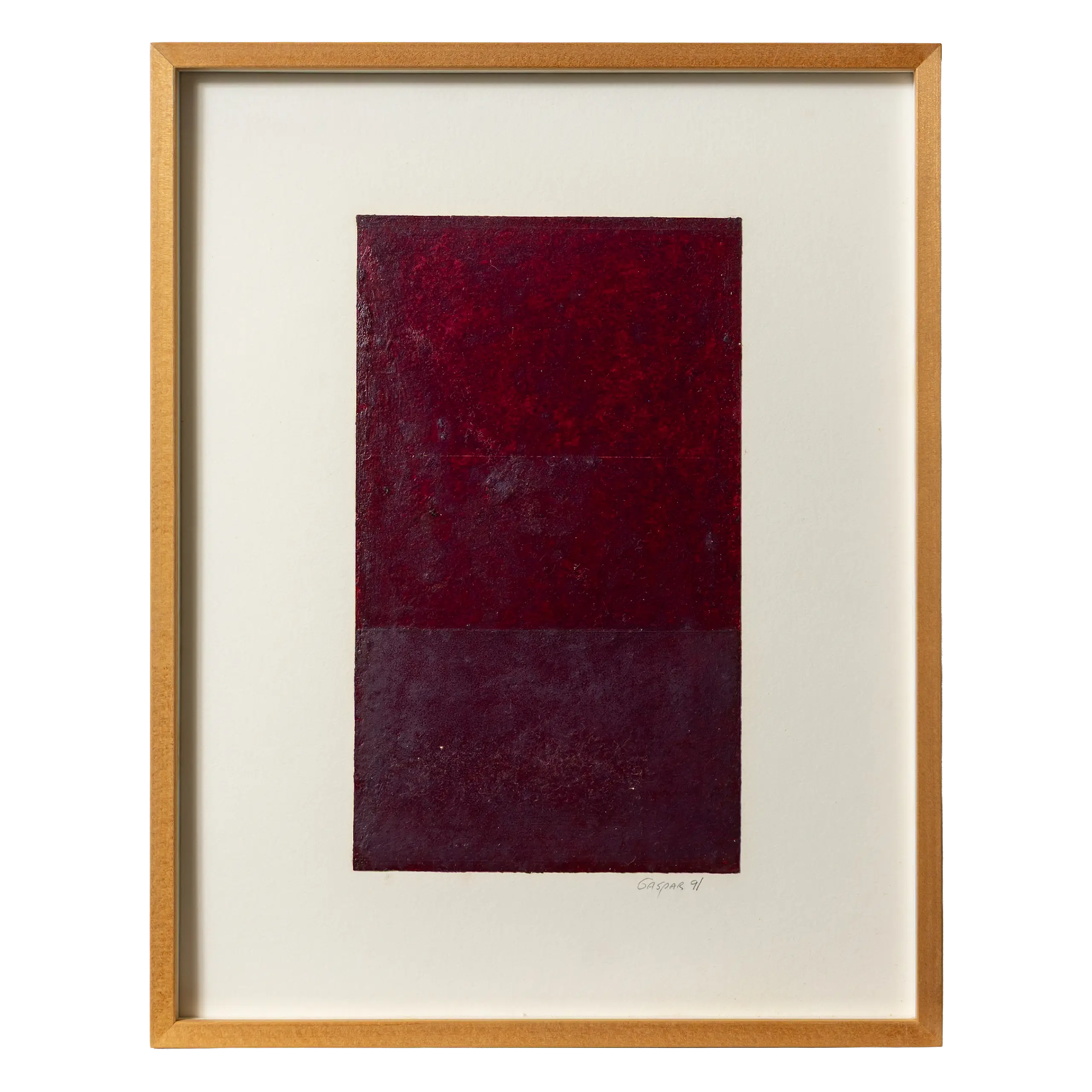
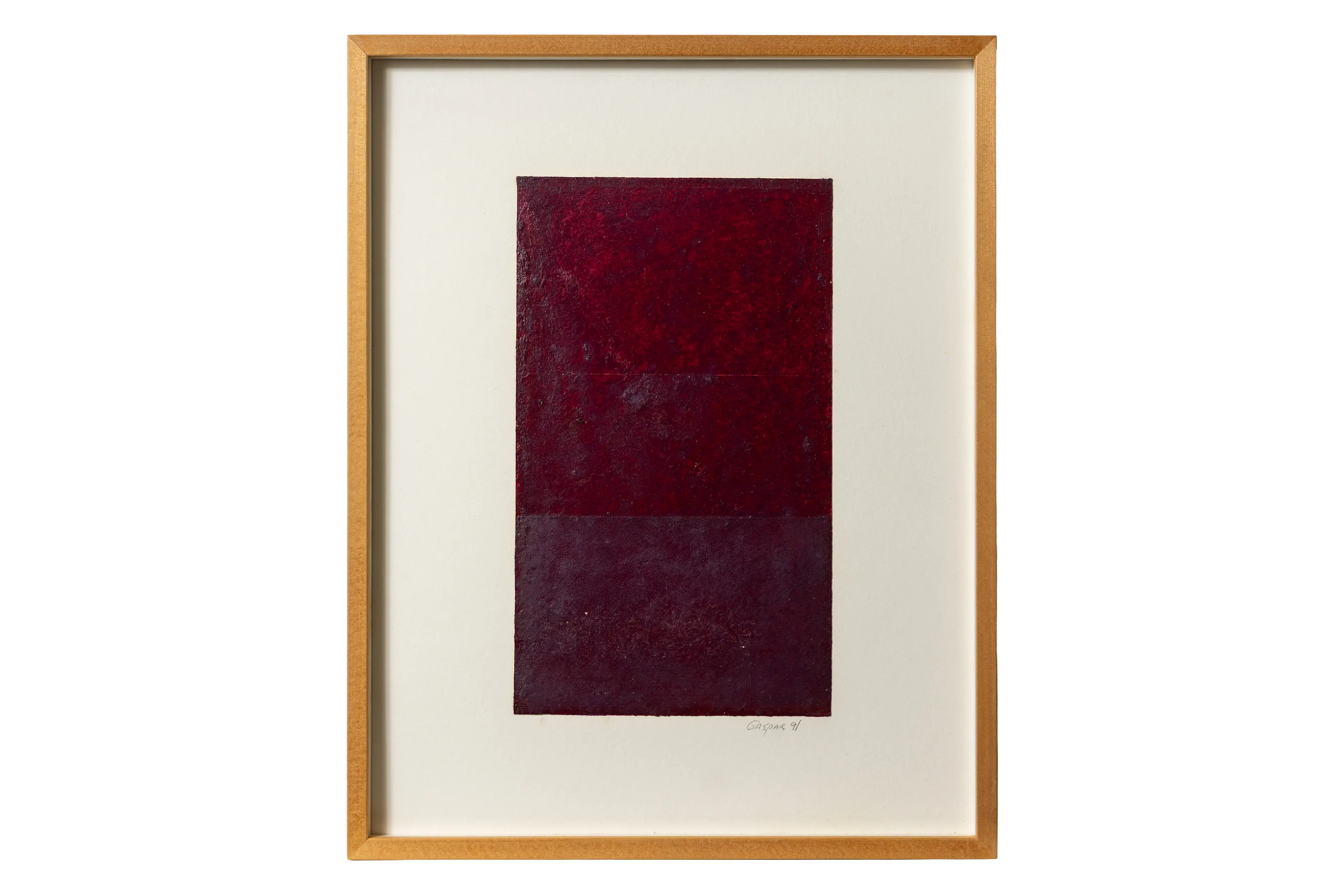
ジョン・ギャスパーは、アメリカを拠点に40年以上にわたって活動している現代の抽象画家です。
ニューヨーク州立大学バッファロー校にて絵画を専攻したギャスパーは、1977年に同大学で美術学士(BFA)を、1980年にはイェール大学芸術学部で美術学修士(MFA)を取得しています。
ギャスパーの作品の多くは限られた色彩で構成されています。一見すると単色のシンプルな画面ですが、凝視し続けると、絵が飾られている空間や光の反射によって絵肌の光沢や凹凸が変化し、見え方が変わる繊細さを備えています。ジャスパー本人はそんな自身の作風について、「塗りこみの密度が濃いという特徴のため、私の作品をロスコのようだと考える人は少なくありません。私自身は、作品の主題を神話的なものだと考えています。私の作品は洞窟壁画であるとも、物語を語る影であるとも言えるでしょう」と述べています。
上記で言及されているのは、「カラーフィールド・ペインティング」と呼ばれる芸術運動の一翼を担ったマーク・ロスコ(1903~1970)です。たしかにロスコの作品は、キャンバスを数少ない色彩で埋めつくすというスタイルから生み出されており、ジャスパー本人も語っている通りその絵肌や画面が与える印象はよく似ています。ただ、ギャスパーの「神話的」や「物語を語る影」といった言葉を踏まえると、そうした表面的な類似性よりも、その背景にある創作の源泉に、ロスコとの共通性を見出していたことが窺えます。ロスコは神話的な主題やシンボルを作品に取り入れ、芸術を理性的な秩序と非合理的な衝動の融合と捉えて自身の精神や哲学を表現してきましたが、ギャスパーもまた、神話が人間の理性と自然界にもたらす影響を、創作を通して探究しているからです。
このように、ロスコから継承している部分が多分に窺えつつも、たとえば1993年には一つの色彩が別の色彩へと侵入し、互いに溶け込みながら混ざり合う曖昧な画面の構成に挑戦するなどして、規則的な色の分割にとらわれず、独自の美学も更新し続けました。また、ギャスパーの作品に見られる幾何学的なパターンや色彩の区画、格子状の構成は、はみだした色彩や変形させた線によって歪みがしばしば生じています。同じくアメリカの抽象画家であるブライス・マーデン(1938~2023)はたびたびギャスパーのアトリエを訪れていますが、マーデンの線の表現、神話に言及したテーマや構成などを踏まえて両者の絵画を比較すると、互いに刺激を受け合いながら創作を発展させたことが想像されます。
これまでにニューヨーク、ロサンゼルス、ワシントンD.C.、デュッセルドルフ、大阪で個展を開催したほか、国内外の数多くのグループ展にも参加したギャスパーは、現代の芸術家たちに多くの影響を与え、ニューヨークの美術界における重要な画家の一人として評価されています。
John GASPAR is a contemporary abstract painter who has been working in the United States for more than forty years.
Gaspar studied painting at the State University of New York College at Buffalo, where he earned a Bachelor of Fine Arts (BFA) in 1977, and received a Master of Fine Arts (MFA) from the Yale University School of Art in 1980.
Many of Gaspar’s works are built from a limited range of colors. At first glance the surfaces look simple and nearly monochrome, yet if one keeps looking, the sheen and unevenness of the paint shift with the space in which the picture hangs and with reflected light, revealing a delicate changeability in how the work is seen. Of this approach Gaspar has said, “I’ve been painting for more than 40 years. Most people think I paint like Rothko because of the intimate nature of the way I apply paint to the surface. I consider my subject matter to be mythic. One might say that they’re cave paintings or shadows that are stories.”
The comparison points to Mark Rothko (1903–1970), who took part in the movement known as Color Field painting. Rothko’s works, too, arise from filling the canvas with few colors, and, as Gaspar himself notes, the impression given by the paint surface and the picture plane is closely akin. Yet, taking Gaspar’s words about the “mythic” and about “shadows that are stories,” one sees that he located a kinship with Rothko less in that surface resemblance than in the sources of making behind it. Rothko brought mythic subjects and symbols into his work and treated art as a fusion of rational order and irrational impulse in order to express his own spirit and philosophy; Gaspar likewise explores, through his making, the influence myth exerts on human reason and on the natural world.
In this way, much that he inherits from Rothko remains visible, while he has also kept renewing a language of his own—for example, in 1993, by attempting compositions in which one color invades another and the two melt and mix into an ambiguous field, unbound by regular divisions of color. The geometric patterns, color blocks, and grid-like structures in Gaspar’s work are often distorted by protruding color and deformed lines. The American abstract painter Brice Marden (1938–2023) often visited Gaspar’s studio; comparing their paintings in light of Marden’s line, and of themes and structures that invoke myth, one can imagine that each stimulated the other as their work developed.
Gaspar has held solo exhibitions in New York, Los Angeles, Washington, D.C., Düsseldorf, and Osaka, and has taken part in many group exhibitions in the United States and abroad. He has influenced many contemporary artists and is regarded as one of the important painters in the New York art world.