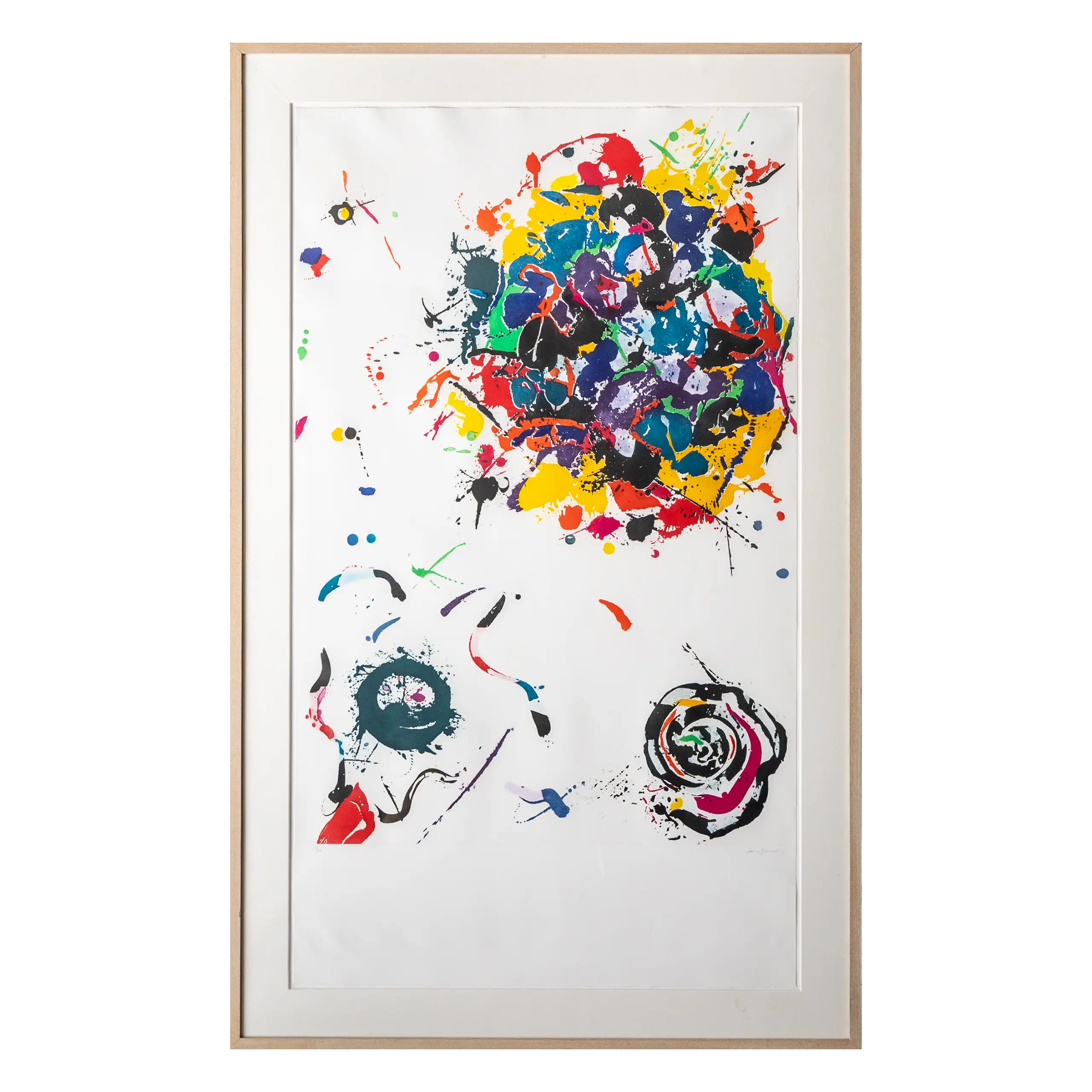
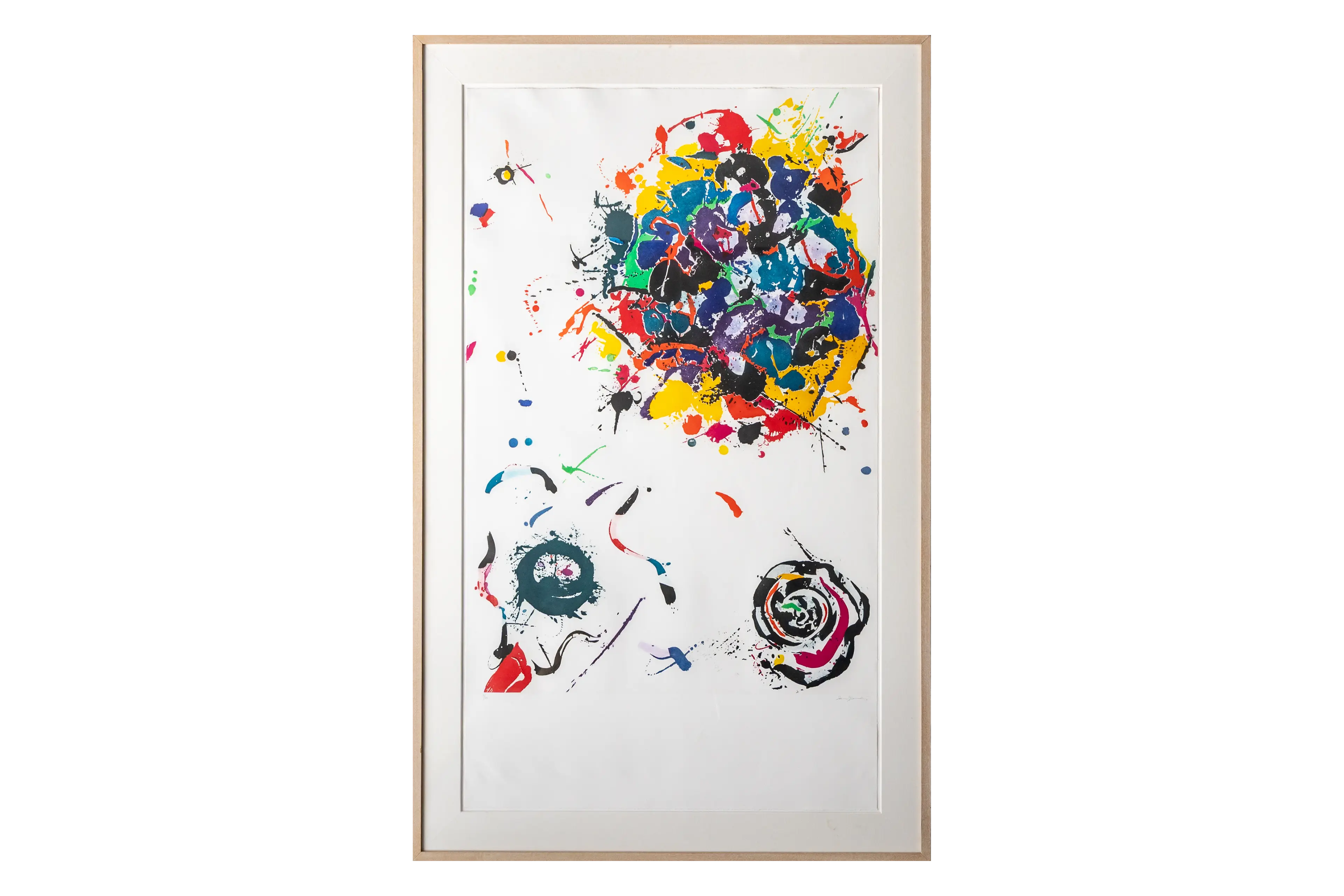
サム・フランシス(1923〜1994)は、20世紀に活躍したアメリカの抽象画家です。抽象表現主義とアンフォルメルの流れを汲みながら、鮮やかな色彩と大胆な余白を特徴とする独自の抽象画を続けました。
カリフォルニア生まれのフランシスは、大学で植物学と心理学、さらに医学を学びました。兵役中の飛行機事故による重傷とその後の長い入院が、画家としての出発点となります。療養中に絵を描き始め、回復後はカリフォルニア大学バークレー校で美術を学びました。1950年にパリへ渡ると、新進画家として注目を集め、50年代前半に初の個展を開き、ミシェル・タピエが企画した展覧会にも参加しました。代表作『Big Red』(1953年)は、初期のモノクロームから色彩豊かな表現へ移っていく時期に制作された作品です。
1950年代後半以降、画面内の白の面積がいっそう大きくなります。『White Line』は、実業家出光佐三がフランシスの作品収集を始めた契機になった作品として知られています。1960年代から70年代にかけては、中央に大きな余白を残す構図、絵具の飛沫、色とりどりの格子状の配列など、多様な画面構成を次々と試しました。
パリ、ニューヨーク、東京などを拠点に活動したフランシスは、出光美術館をはじめ日本の公的コレクションにも多数の作品が所蔵されています。フランス近代絵画に加え、アジア文化や禅との接触も、制作の幅を広げる要因の一つとなりました。
Sam FRANCIS (1923–1994) was an American abstract painter active in the twentieth century. Drawing on Abstract Expressionism and Art Informel, he developed a distinctive abstract style marked by vivid color and bold use of empty space.
Born in California, Francis studied botany, psychology, and medicine at university. A plane crash during his military service left him seriously injured and led to a long hospital stay that became his starting point as a painter. He began to paint during his recuperation and later studied art at the University of California, Berkeley. In 1950 he moved to Paris, where he attracted attention as a young painter, held his first solo exhibitions, and took part in shows organized by Michel TAPIÉ, a leading advocate of Art Informel. "Big Red" (1953), one of his key works from this period, belongs to his shift from early monochrome paintings toward richer color.
From the late 1950s onward, white occupied an ever larger share of his bright canvases. "White Line", with white running through the center of the composition, is also known as the work that prompted the industrialist Sazo Idemitsu to begin building a collection of Francis's work. From the 1960s through the 1970s, he continued to test varied formats, including compositions with a large central void, emphatic paint splashes, and multicolored grid-like structures.
Working between Paris, New York, and Tokyo, Francis left many works in public collections in Japan, including the Idemitsu Museum of Arts. Exposure to French modern painting, along with Asian culture and Zen Buddhism, also became an important part of his practice.