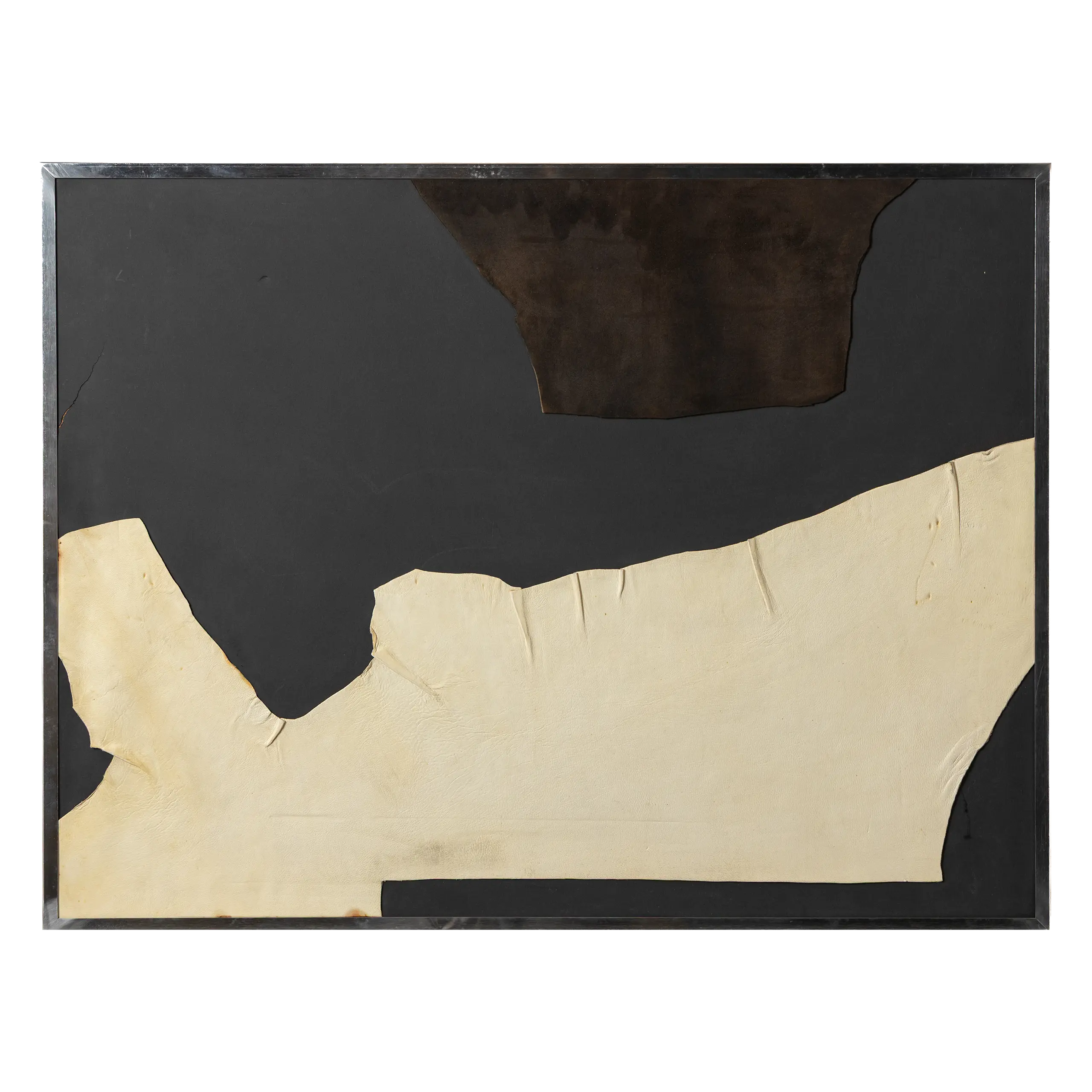
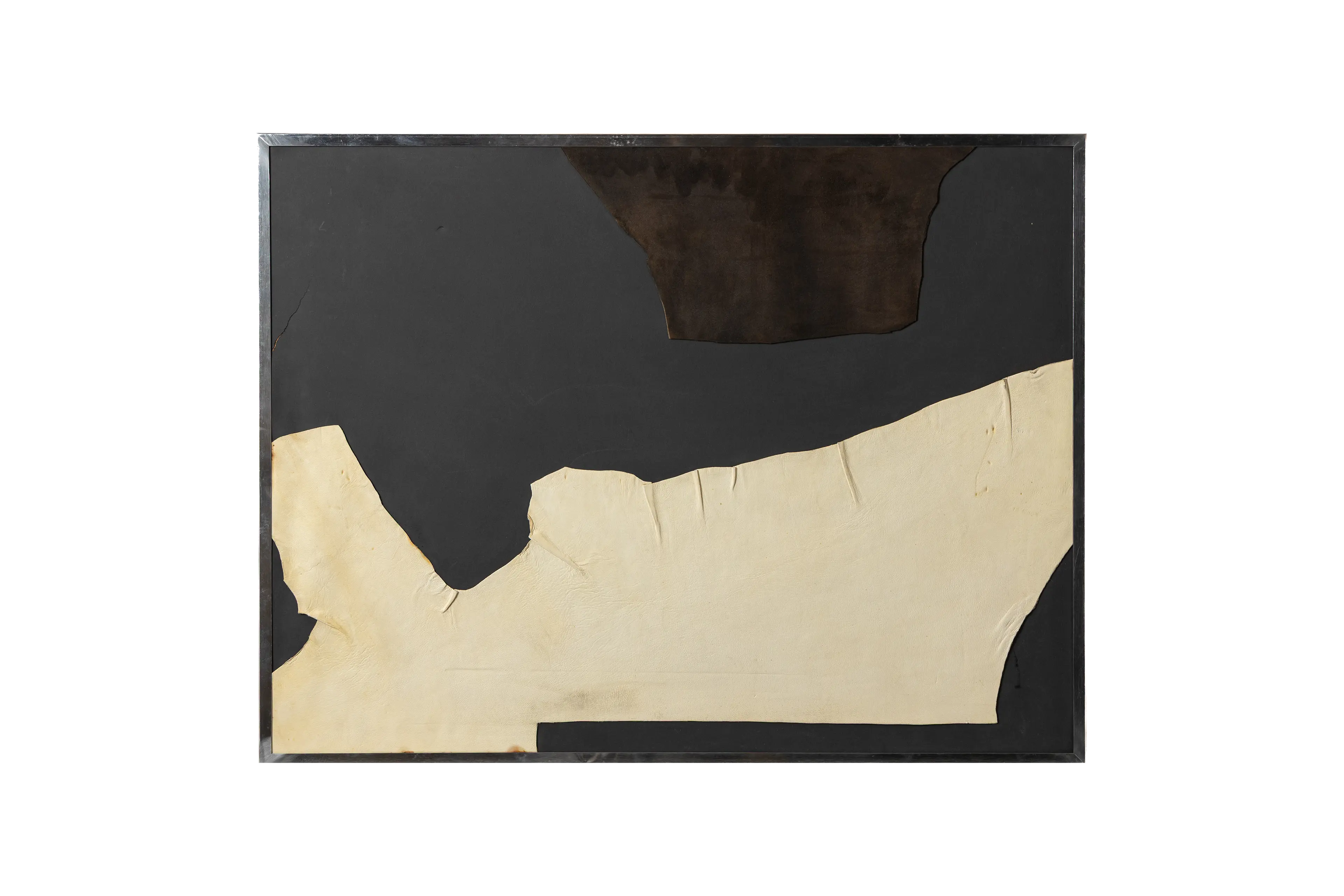
瓦林睦生(1934~1998)は、福岡県出身の画家/版画家です。レリーフ状のカンヴァス作品やステンレススチールを使った立方体の彫刻で知られており、それらを制作する過程で作品が空間に与える影響や最小限の「かたち」を生涯かけて追求しました。
小学生の頃、児童画展に出品した落下傘部隊の絵画が銀賞を獲得したことをきっかけに絵を描き続けていたものの、美術大学へ進むことは許されず、中央大学法学部に進学することとなりました。それでも、大学在学中に二科展に作品を発表するなど、創作への関心は弱まることなく、卒業後は福岡のラジオ九州(現・RKB毎日放送)に、翌年から始まるテレビ放送用の美術セットのデザイン要員として就職しました。
そんな彼が本格的に芸術の道を歩んでいく決め手となるのが、1963年の渡仏です。27、28歳のときに仕事を一年ほど休み、そのあいだに開いた個展による収入でパリへ渡ると、イタリアやスペインにも足を運び、現地の美術の動向に触れました。抽象表現主義から新しい具象へと流行が移り変わる最中、「出来るだけ簡素化し、計算をしたパターンの生命力を創るには幾何学的な構成が適している」と考え、ジオメトリックな形象の世界に強く惹かれるようになります。そこで生み出されたものが、「レリーフ・コンポジション」シリーズです。カンヴァスの上に牛のなめし皮や、金属板で作った円や楕円といったモチーフを貼りつけ、明快な原色がむらなく塗りこめられた作風は、総じて「無機的」「硬くて渇いた印象」などと表現される一方、詩人で美術評論家の岡田隆彦(1939~1997)は「冷涼な感じをも与えるのだが、どこかにこまやかな情感とぬくもりとがあって、一べつしたときに感じられる作品の無表情さをつきくずしている」といった点から、「人間の世界の感情的な機微の興趣といったことよりも宇宙の世界の原理的な追及に腐心」していると分析しています。
上記のレリーフ作品の一つは、1967年の第4回国際青年美術家展において文部大臣賞を受賞していますが、帰国後、70年代に入ると、瓦林は「かたち」の存在をより強く押し出すことにこだわり、不要なものをさらにそぎ落とした彫刻作品の制作に舵を切ります。素材の持つ冷たさを好んでステンレススチールを採用し、初めは鏡面仕上げで円や曲線を取り入れていましたが、この手法では有機性が残り、また周囲の景色を映しこんで作品の「かたち」が消えてしまう難点がありました。そこで直線と面のみを扱い、ヘアライン仕上げにすることによって、研ぎ澄まされた存在感と緊張感を生み出すことに成功します。厳密には、内部は鉄でできており、その上にステンレススチールをかぶせているため、形状はより鋭く、周囲の空間すら一つの作品として取り込む強度を備えています。1975年の個展で発表したような、ステンレススチールの枠のなかに、同じ素材の立方体を置いた作品では、両者のあいだにあるすきま自体も作品の一部として機能しています。瓦林は、一貫して作品の「かたち」、そしてそれが周囲に与える影響によって決定づけられる空間の意味や必然性について考え続けましたが、その先で行きついたこれらの彫刻は、まさしく作品の存在によって新たな環境をつくりあげるという、彼の追い求めた創作のありかたにほかなりません。
Mutsuo Kawarabayashi (1934–1998) was a painter and printmaker from Fukuoka Prefecture. He is known for relief-like canvas works and cubic sculptures in stainless steel, and throughout his life he pursued the effect of a work on the surrounding space and the most minimal “form,” through the process of making them.
As an elementary-school student he kept painting after a picture of a paratroop unit, entered in a children’s art exhibition, won a silver prize. He was not permitted to go on to an art university, however, and instead entered the Faculty of Law at Chuo University. Even so, his interest in making art did not fade: while still a student he showed work in the Nika Exhibition, and after graduating he joined Radio Kyushu in Fukuoka (now RKB Mainichi Broadcasting) as a staff designer of art sets for the television broadcasts that would begin the following year.
What decided him to pursue art in earnest was his trip to France in 1963. At twenty-seven or twenty-eight he took about a year off from work and, with income from a solo exhibition held in that period, went to Paris; he also traveled to Italy and Spain and encountered local artistic trends. Amid a shift in fashion from Abstract Expressionism toward a new figuration, he came to believe that “to simplify as far as possible and create the vitality of a calculated pattern, geometric composition is best suited,” and was strongly drawn to a world of geometric forms. What emerged from that was the “Relief Composition” series. Motifs such as circles and ellipses made of tanned cowhide or metal sheet were affixed to the canvas and clear primary colors were applied evenly; the overall manner has been described as “inorganic” and as leaving a “hard, dry impression.” By contrast, the poet and art critic Takahiko Okada (1939–1997) analyzed that, while the works “also give a cool sensation, somewhere they hold a delicate feeling and warmth that undo the impassivity one senses at a glance,” and that Kawarabayashi was “less concerned with the interest of emotional nuance in the human world than with a principled inquiry into the cosmic world.”
One of these relief works received the Minister of Education Award at the 4th International Young Artists Exhibition in 1967. After returning to Japan, in the 1970s Kawarabayashi became more intent on pressing the presence of “form” itself and turned toward sculpture that pared away still more of what was unnecessary. Preferring the coldness of the material, he adopted stainless steel. At first he used a mirror finish and incorporated circles and curves, but that approach left a residue of organic quality, and it also reflected the surrounding scenery so that the work’s “form” disappeared—a drawback. By working only with straight lines and planes and using a hairline finish, he succeeded in producing a sharpened sense of presence and tension. Strictly speaking, the interior is iron, covered with stainless steel, so the shapes become sharper still and gain the strength to take in even the surrounding space as part of a single work. In pieces shown at a 1975 solo exhibition, for example—a stainless-steel cube set inside a frame of the same material—the gap between the two itself functions as part of the work. Kawarabayashi consistently thought about the “form” of the work and about the meaning and necessity of space as determined by its effect on the surroundings; the sculptures he reached in that pursuit are precisely a way of making in which a new environment is created by the presence of the work—the approach he sought.