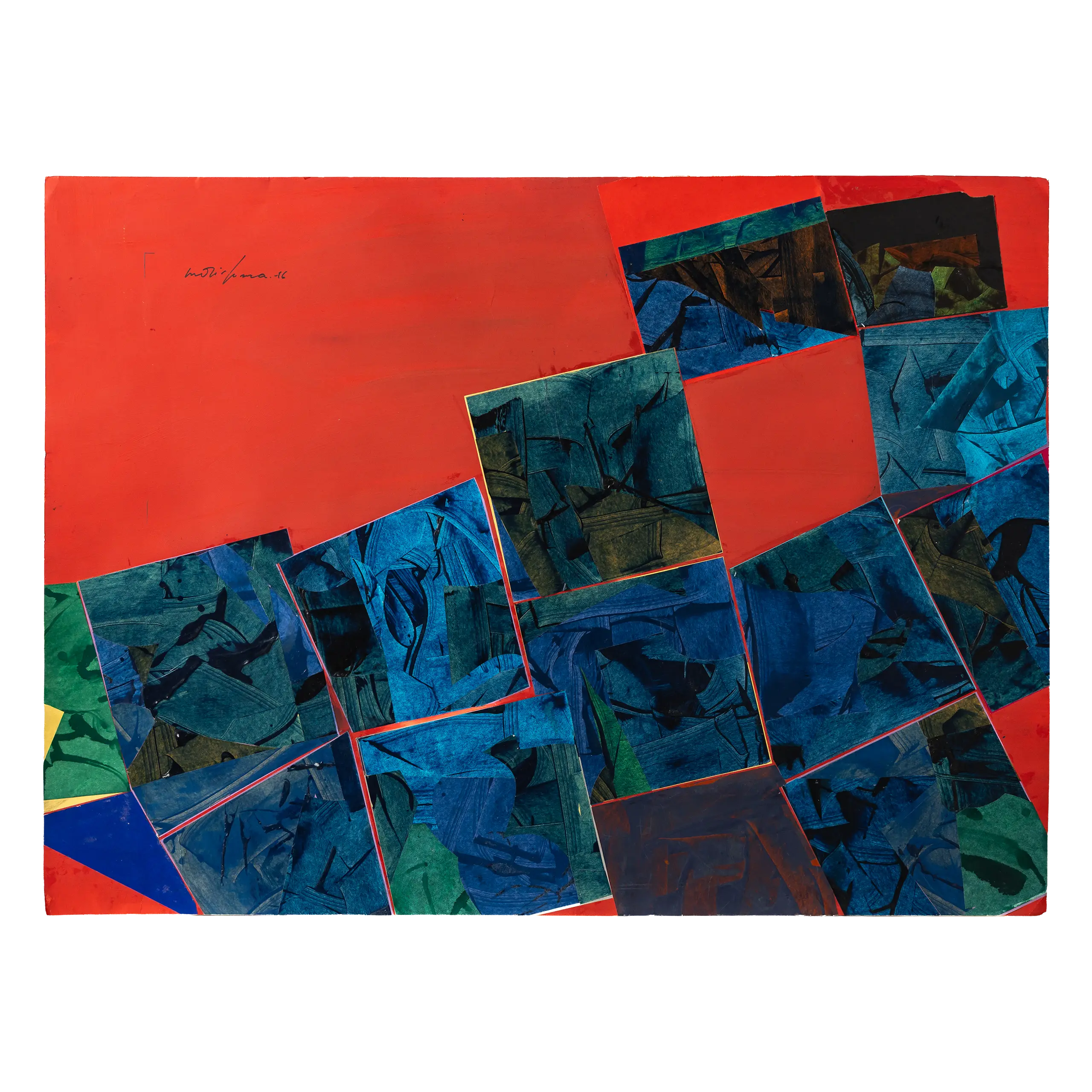
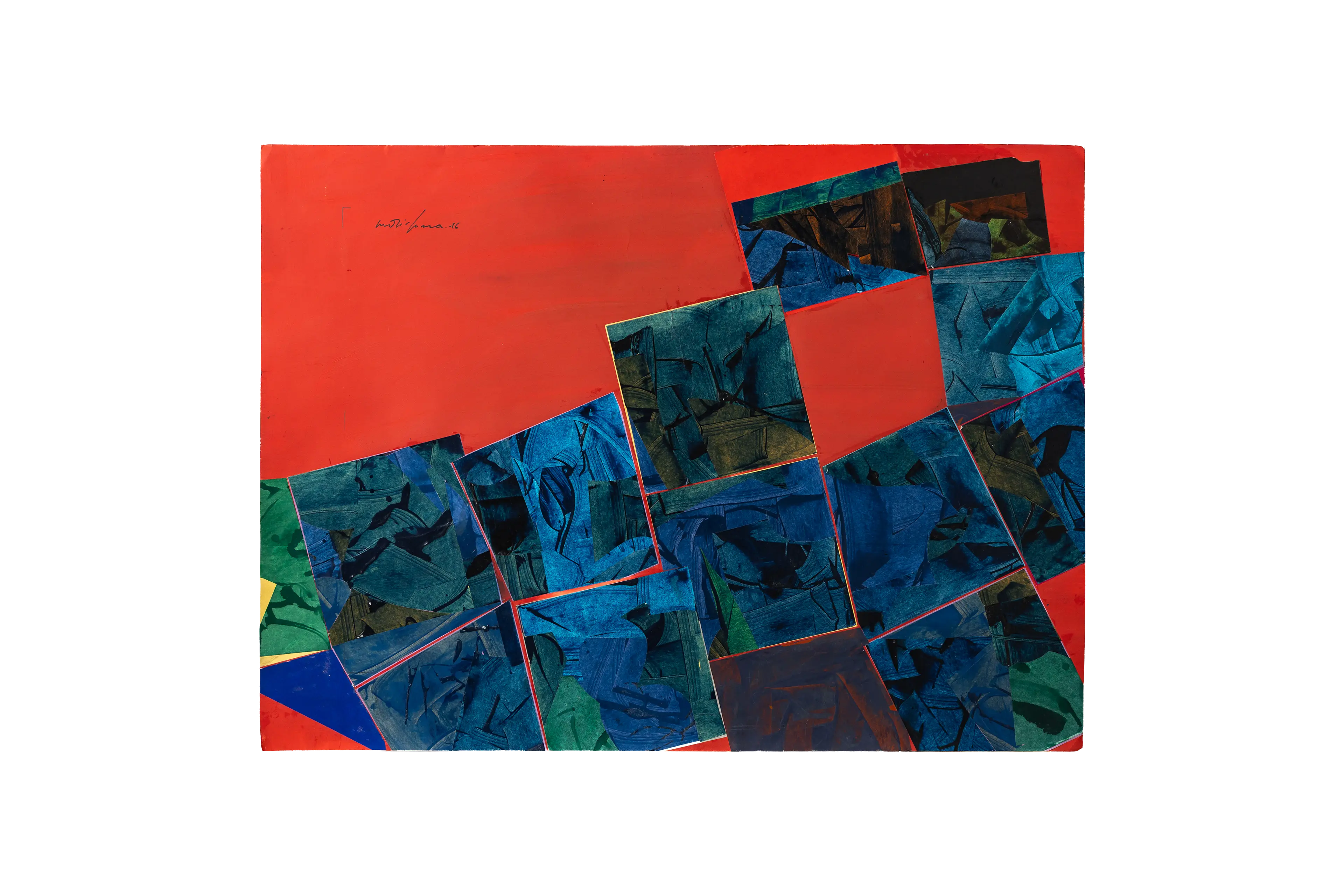
森島澄子はパリに12年滞在し、大胆な筆跡が印象的な抽象画や詩情豊かなコラージュなど、多彩な作品を手がけた芸術家です。
記録や研究がまだ少ない作家ですが、1931年に三重県に生まれ、女子美術大学を卒業しているほか、1954年の時点で第14回一水会展に出品していたことなどが資料に残っています。なお、一水会とは、「西洋絵画の伝統である写実の本道を守り、安易な会場芸術を非とし、技術を重んじ高雅なる芸術をめざす」という創立精神のもと、1936年に有島生馬(1882~1974)らが結成した美術団体です。また、1957年に開催された第9回日本アンデパンダン展の出品目録には、森島の作品として【破壊】という洋画が記載されています。さらに、シュルレアリスムの洋画家である米倉壽仁(よねくらひさひと・1905~1994)を中心に発足したサロン・ド・ジュワンという美術団体への所属も確認されています。こちらは「流行をいたづらに追わず、陳腐とアカデミズムをきらい、常に新しさを要求する」若い作家たちの集まりであり、『みづゑ(674)』(美術出版社、1961年6月)においては森島の名前もメンバーとして挙げられたうえで「作家たちがいずれも全力をあげて絵画ととり組んでいる態度が好感が持てる」との評価を受けています。渡仏前の森島のこうした足取りをたどると、西洋絵画への関心や、堅実さと前衛性の両方を備えたバランスのよい作家性が窺えます。
1963年にパリに渡ると、スペインやモロッコも旅しつつ、パリ近郊の水の街ブリュノワにあるエピネー=シュル=セーヌというコミューンを拠点に活動を展開します。個展を精力的に開催したほか、国際女流作家展への出品や国際グラフィック・ポメエロ展での受賞など、画家としての頭角を現していきました。帰国後、美術関連の雑誌や広告などでは、「パリに渡って12年、『現代ヨーロッパの注目すべき新鋭女流作家』と評される画家の個展。心象の世界を描くコラージュとシルクスクリーン」(『週刊文春17(8)(816)』文芸春秋、1975年2月)、「装飾性芸術のジャンルで傑出した作行を見せる稀代の女流作家」(『芸術新潮28(7)(331)』新潮社、1977年7月)といったコピーで宣伝されていました。
このような作風は、90年代に入ってからも貫かれていたようです。たとえば、1994年に横浜で開催された、現代美術を扱う第3回NICAFEヨコハマ‘94では、藤沢のギャラリーLife Art丸山から「その日本人特有の繊細な感性と洗練されたヨーロッパのセンスが融合した作品には現代の中に『みやび』とさえ表現し得る華麗な世界を現出している」と紹介されています。ちなみに、そこで出品された油彩画【薔薇色がかった形】(1994年)は、深みのある赤色で作者の筆跡を残した、躍動感と繊細さが併存する抽象画です。フランスでの旅の思い出をテーマにした1995年の個展では、【風景ノアール】というコラージュ作品を発表しています。そのほか、総合誌である『東京人』の1991年2月号の特別付録「TOKYO WALKING」では、千鳥ヶ淵水上公園、上野公園、雷門の3か所をやわらかなタッチで描いた水彩画を寄稿しています。ジャンルや技法は幅広いながら、どの作品にも、たおやかな感性によって作りだされた詩的な世界観が共通しているといえるでしょう。
Sumiko Morishima is an artist who lived in Paris for twelve years and produced a wide range of work, from abstract paintings marked by bold brushwork to richly lyrical collages.
Although records and research on her remain limited, sources show that she was born in Mie Prefecture in 1931, graduated from Joshibi University of Art and Design, and by 1954 was already exhibiting in the 14th Issuikai Exhibition. Issuikai is an art association founded in 1936 by Ikuma Arishima (1882–1974) and others under the founding principle of “upholding the true path of realism in the Western painting tradition, rejecting facile exhibition art, valuing technique, and aiming for refined art.” The checklist for the 9th Japan Independent Exhibition, held in 1957, also lists a Western-style painting by Morishima titled “Destruction.” She is further recorded as belonging to Salon de Juin, an art group formed around the Surrealist Western-style painter Hisahito Yonekura (1905–1994). It was a gathering of younger artists who “did not chase fashion for its own sake, disliked the stale and academic, and always demanded the new.” In Mizue no. 674 (Bijutsu Shuppan-sha, June 1961), Morishima’s name appears among the members, with the comment that “the artists’ attitude of giving their all to painting is appealing.” Tracing these steps before her departure for France, one can see both an interest in Western painting and a balanced artistic temperament that held firmness and avant-garde qualities together.
After going to Paris in 1963, she also traveled in Spain and Morocco while basing her work in the commune of Épinay-sur-Seine, in Brunoy—a waterside town near Paris. She held solo exhibitions energetically, showed in the International Women Artists Exhibition, and received an award at the International Graphic Pomelo Exhibition, emerging as a painter in her own right. After her return to Japan, art magazines and advertisements promoted her with lines such as: “A solo exhibition by a painter who spent twelve years in Paris and is called ‘a notable young woman artist of contemporary Europe.’ Collages and silkscreens that depict a world of the mind” (Shukan Bunshun 17, no. 8 [816], Bungeishunju, February 1975); and “a rare woman artist who shows outstanding work in the genre of decorative art” (Geijutsu Shincho 28, no. 7 [331], Shinchosha, July 1977).
This manner of working appears to have continued into the 1990s as well. At the 3rd NICAFE Yokohama ’94, a contemporary-art event held in Yokohama in 1994, Gallery Life Art Maruyama in Fujisawa introduced her work as follows: “Her works, in which a distinctly Japanese delicate sensibility fuses with refined European taste, bring forth a brilliant world that can even be called ‘miyabi’ within the contemporary.” The oil painting “Rosy Form” (1994), shown there, is an abstract work in deep red that retains the artist’s brush marks, holding movement and delicacy together. At a 1995 solo exhibition on memories of travel in France, she presented the collage “Landscape Noir.” Elsewhere, in the February 1991 special supplement “TOKYO WALKING” of the general magazine Tokyo Jin, she contributed watercolors of Chidorigafuchi Water Park, Ueno Park, and Kaminarimon, painted with a soft touch. Across a wide range of genres and techniques, the works share a poetic world shaped by a gentle sensibility.