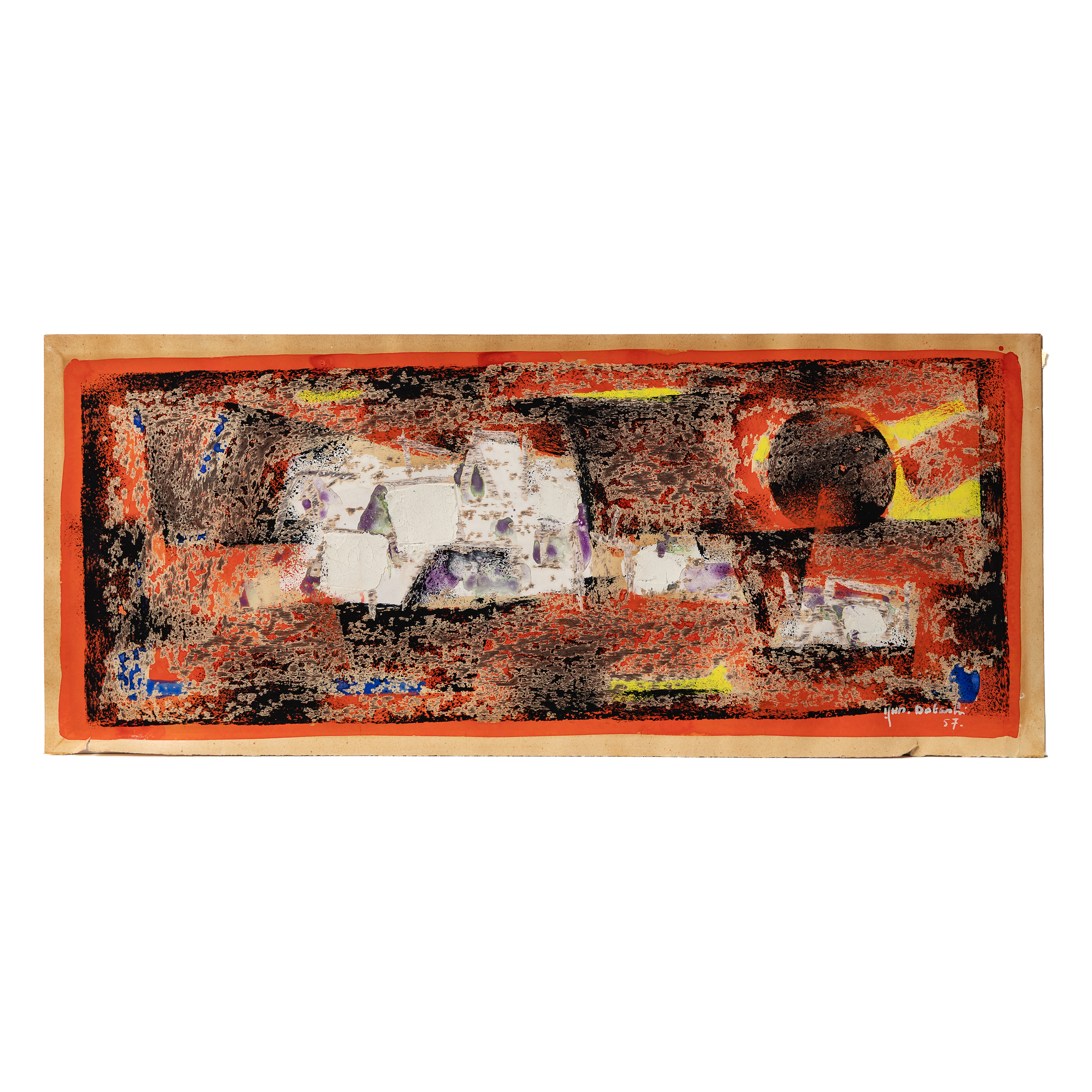
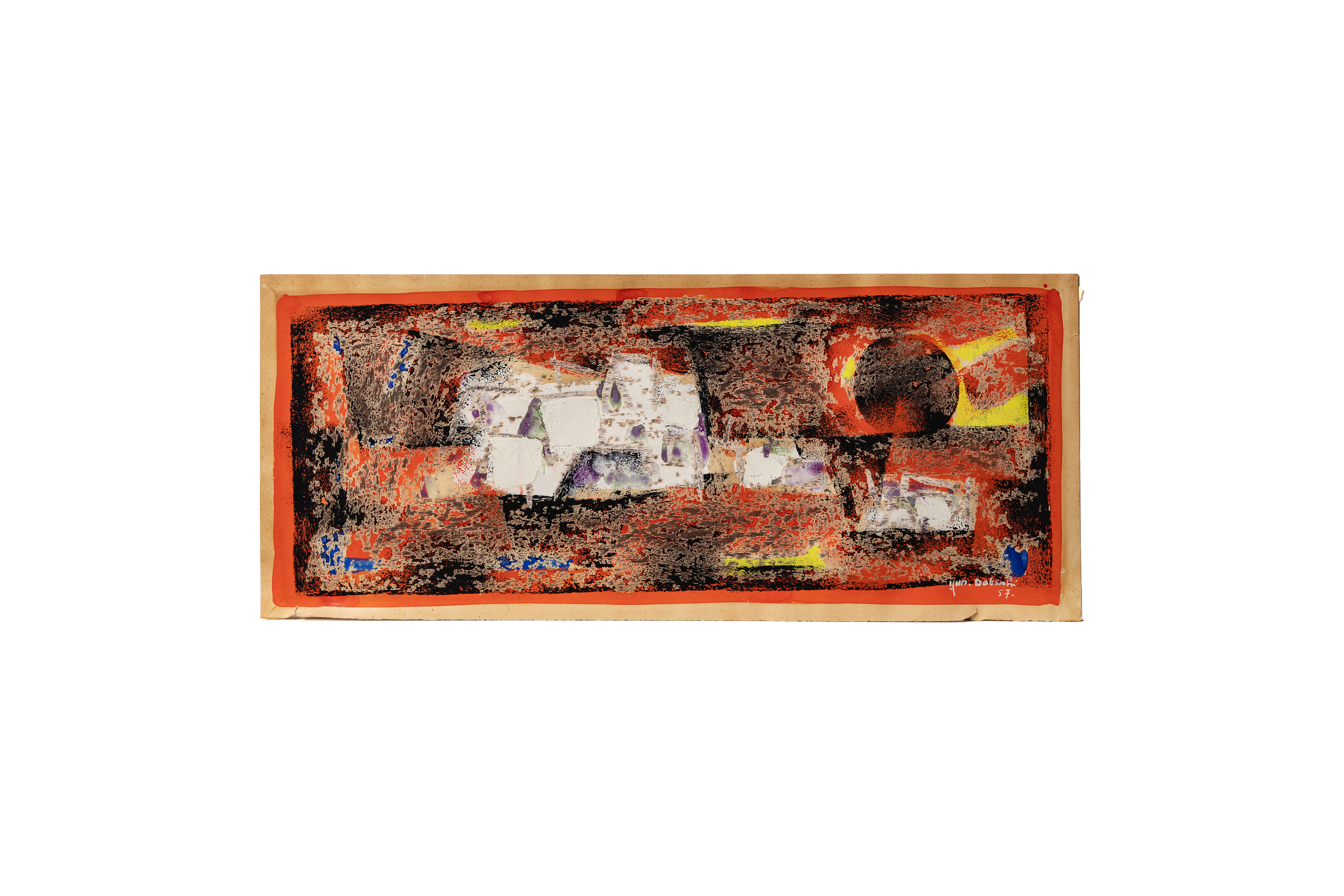
土橋醇(1909~1978)は、1950年代から60年代のパリで活躍した洋画家です。
東京の小石川に生まれた土橋は、日本画家であった父の三郎が28歳で夭折すると、祖父母の暮らす福島県安積郡湖南町赤津(現・郡山市湖南町赤津)に移り、そこで少年時代を過ごします。1933年には東京美術学校油画科に入学し、日本近代洋画の巨匠である岡田三郎助(1869~1939)に師事しました。同大学を卒業した1938年にパリに渡り、美術学校アカデミー・ランソンで学んでいたものの、第二次世界大戦の勃発により1940年に帰国を余儀なくされます。戦後、1953年に再び渡仏し、藤田嗣治(1886~1968)をはじめとする日本の芸術家と親交を深めながら、同地で隆盛していたアンフォルメル運動からも刺激を受けました。
その後、帰国するまでの約20年間、パリのギャラリーを拠点に活動し、ニューヨークやドイツなど欧米で個展やグループ展を開催しました。実景をもとにして生まれた、土橋の抒情的な抽象画は、国際画壇において高い評価を得ています。初期は、【幻想の門】(1956年)や【火の誕生】(1956年)のように、深みのある黒や赤を多く用いた重量感のある画風が特徴的でしたが、60年代に入ると次第に白や青といった新しい色のほか、鉄などの素材が取り入れられ、モチーフのかたちも多様化したことで動きのある画面構成となり、土橋が自然から得たインスピレーションがより一層鮮やかに昇華されていくようになります。東京国立近代美術館に所蔵されている【流れる星(白)】(1965年)は、タイトルの通り星の流れゆくさまが、静謐でありながら躍動感にもあふれて描かれた土橋の代表作のひとつです。帰国した年である1973年制作の【スペインの幻想】は、ややデフォルメされたスペインの街並みに、抽象的なモチーフが重なる構成となっており、土橋が実際の風景を創作の源泉としているのがより明確に伝わる作品です。
人物としては、明るく親しみやすい性格とたくましい肉体を持ち、質朴な雰囲気のなかに繊細な感性を潜ませていたと語られています。『土橋醇作品集 1956-1967』(三彩社、1967年)には、パリ滞在時の土橋と交流のあった作家の田村泰次郎(1911~1983)が以下のような文章を寄せています。「土橋さんの仕事ぶりは、凄まじいものだった。アトリエのなかにはいりきらない大きな制作は、中庭に持ちだして、ランニングシャツ一枚になって、とっ組んでいた。彼は自分の可能性に挑むかのように、つぎつぎとよく大作にとっくんでいた。(原文ママ)」芸術の都である華やかなパリと、その町中でこつこつと、泥臭く制作に励む芸術家の姿が対照的に描きだされている貴重な資料の一つです。
1977年には、故郷の湖南町に自ら設計したアトリエ「愚魚庵」を構えており、新たなステージへの移行が期待されましたが、残念ながらその翌年に同地で亡くなってしまいます。2023年には、「土橋醇展 パリ、湖南―幻想を追って」にて作品100点が展示され、国外で戦後の前衛美術を切り拓いた作家の画業が紐解かれ、再評価の機運が高まっています。
Jun Dobashi (1909–1978) was a Western-style painter who was active in Paris in the 1950s and 1960s.
Born in Koishikawa, Tokyo, Dobashi moved after the early death of his father, Saburo—a nihonga painter who died at twenty-eight—to Akatsu in Konan-machi, Asaka County, Fukushima Prefecture (present-day Akatsu, Konan-machi, Koriyama), where his grandparents lived, and spent his boyhood there. In 1933 he entered the Oil Painting Department of the Tokyo School of Fine Arts and studied with Saburosuke Okada (1869–1939), a leading figure in modern Japanese Western-style painting. After graduating in 1938, he went to Paris and studied at the Académie Ranson, but the outbreak of World War II forced him to return to Japan in 1940. After the war he went to France again in 1953, deepened friendships with Japanese artists including Tsuguharu Foujita (1886–1968), and also drew stimulus from the Art Informel movement then flourishing there.
For roughly twenty years until his return, he worked from galleries in Paris and held solo and group exhibitions in New York, Germany, and elsewhere in Europe and the United States. Dobashi’s lyrical abstractions, born from observed landscapes, have been highly regarded on the international art scene. In his early period, as in “Gate of Fantasy” (1956) and “Birth of Fire” (1956), his work was marked by a weighty manner that made ample use of deep blacks and reds. In the 1960s he gradually introduced new colors such as white and blue, as well as materials such as iron; the forms of his motifs also diversified, yielding more dynamic compositions in which the inspiration he took from nature was distilled with still greater vividness. “Shooting Stars (White)” (1965), in the collection of the National Museum of Modern Art, Tokyo, is one of his representative works: as the title suggests, it depicts the flow of stars with both quietude and a strong sense of movement. “Spanish Illusion,” painted in 1973—the year of his return to Japan—combines a somewhat distorted Spanish townscape with overlapping abstract motifs, and makes still clearer that actual scenery was a source for Dobashi’s work.
As a person, he is described as having had a bright, approachable character and a sturdy physique, with a delicate sensibility beneath a plain, unaffected manner. In Works of Jun Dobashi, 1956–1967 (Sansai-sha, 1967), the writer Taijiro Tamura (1911–1983), who knew Dobashi during his years in Paris, contributed the following: “Dobashi’s way of working was ferocious. Large works that would not fit inside the studio were carried out into the courtyard, and he would wrestle with them in nothing but a sleeveless undershirt. As if challenging his own possibilities, he tackled one large piece after another. (as in the original).” It is one of the rare documents that set the glittering capital of art against the image of an artist working steadily, even roughly, in the midst of that city.
In 1977 he established “Gugyoan,” a studio he designed himself, in his hometown of Konan-machi, and a new stage of work was anticipated; regrettably, he died there the following year. In 2023, the exhibition “Dobashi Jun: Paris, Konan—in pursuit of fantasy” presented one hundred works, tracing the career of an artist who helped open postwar avant-garde art abroad and contributing to a renewed wave of reassessment.