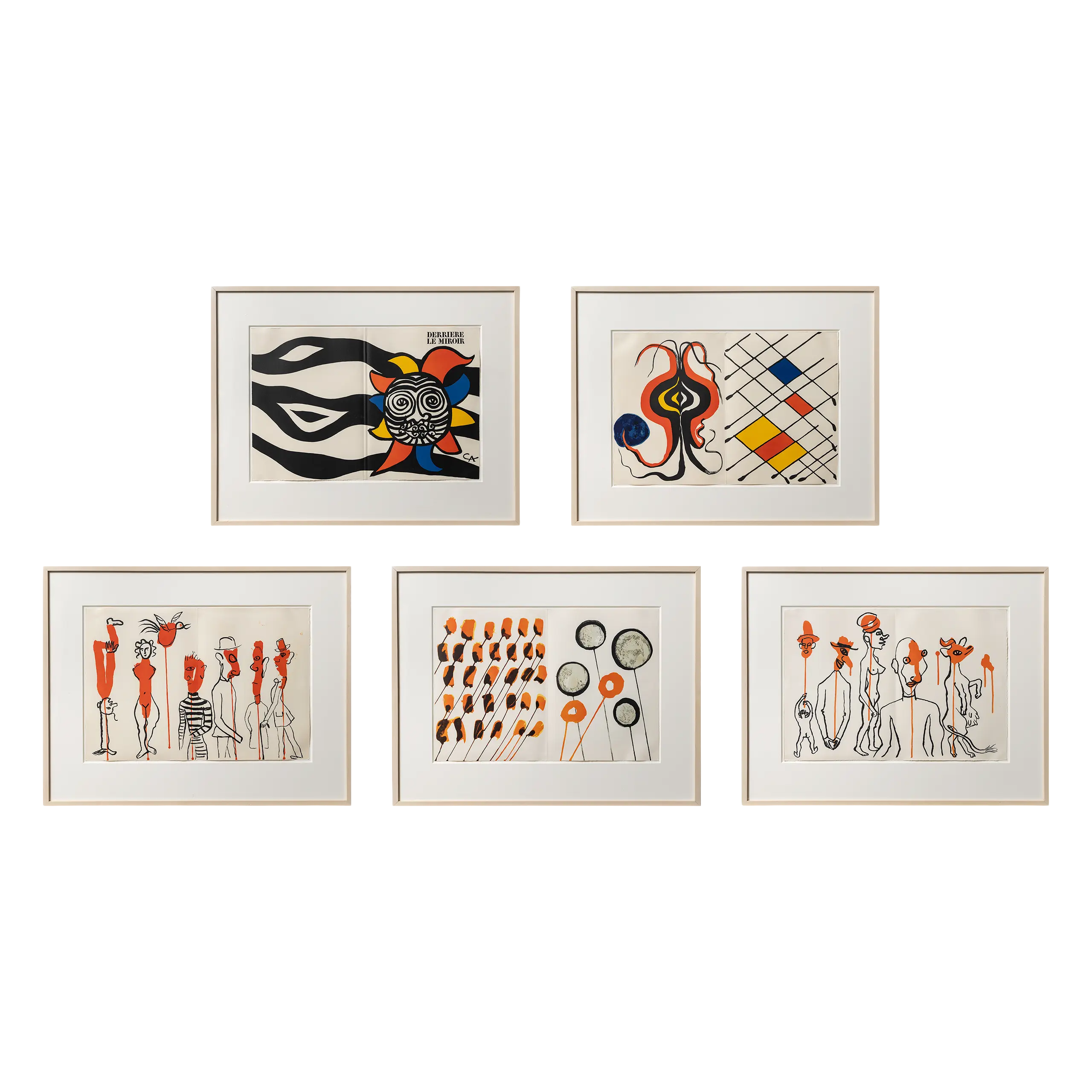
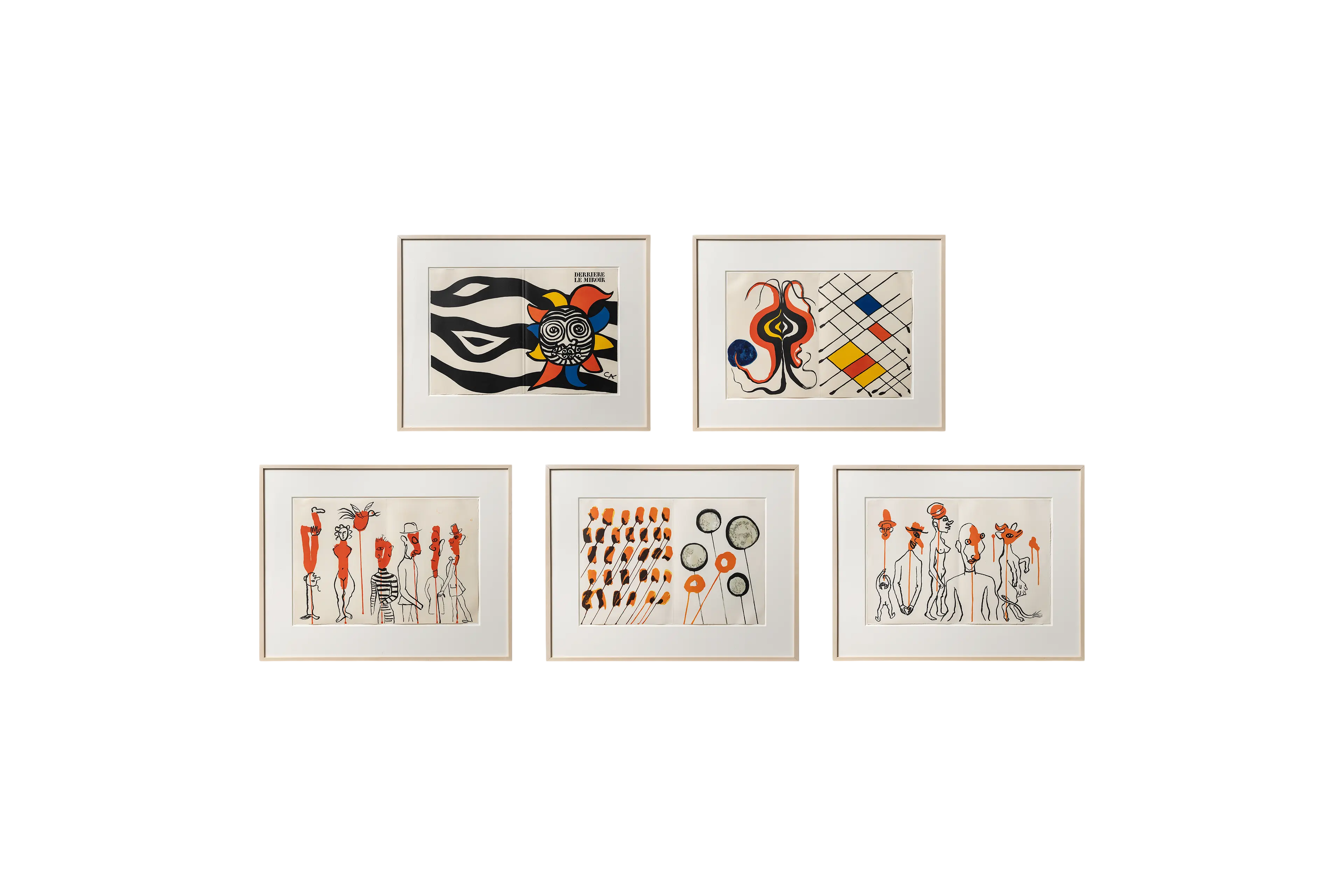
アレクサンダー・カルダー(1898〜1976)は、「モビール」を発明したことで知られるアメリカの彫刻家です。強い原色を好んで使用したため「色彩の魔術師」の異名を持ち、ワイヤーによる具象表現、形を変える抽象彫刻、さらには屋外での大作まで、幅広い造形を手がけました。
カルダーは1898年にアメリカに生まれ、彫刻家の父と画家の母のもとで育ちました。1919年にスティーブンス工科大学を卒業したのち、1923年にニューヨークのアート・スチューデンツ・リーグで学びます。1926年にパリへ移り、一筆書きを活かした針金彫刻を始めます。その後、ワイヤーや布などを用いたパフォーマンスイベント『Cirque Calder』(1926〜1931)を制作し、自ら演じて見せました。1930年、ピート・モンドリアンのアトリエを訪れたことをきっかけに抽象に惹きつけられ、動く彫刻「モービル」を発明します。「モビール」は天井からワイヤーなどで金属片やプラスチック板を吊り下げたもので、わずかな風や空気の振動を捉えて、複雑で優雅なゆらぎを見せます。カルダーと交流のあった美術家であるマルセル・デュシャンが「モビール」と命名し、対して静止した抽象作品を「スタビール」と呼びます。
ザ・ミュージアム・オブ・モダン・アート(MoMA)所蔵の『ロブスターの罠と魚の尾』(1939年)はスタンディング・モビールの代表作です。彫刻の森美術館所蔵の『赤い三角旗』(1970年)は日本で見ることができるカルダーの作品のひとつです。1960年代以降はフランスやアメリカでの屋外の大作制作にも取り組みました。1976年、ニューヨークで死去しました。彫刻の表現方法を広げたカルダーは、動的芸術の先駆けとして位置づけられています。
Alexander Calder (1898–1976) was an American sculptor known for inventing the “mobile.” Fond of strong primary colors, he earned the epithet “magician of color,” and worked across a wide range of forms—from figurative wire sculpture and abstract sculpture that changes shape to monumental outdoor works.
Calder was born in the United States in 1898 and grew up with a sculptor father and a painter mother. After graduating from the Stevens Institute of Technology in 1919, he studied at the Art Students League in New York in 1923. In 1926 he moved to Paris and began making wire sculptures that draw on a continuous, single-line quality. He then created Cirque Calder (1926–1931), a performance piece using wire, cloth, and other materials, which he presented himself. In 1930, a visit to Piet Mondrian’s studio drew him toward abstraction, and he invented the moving sculpture known as the “mobile.” A mobile hangs metal pieces or plastic sheets from the ceiling on wire and the like, catching slight breezes or vibrations in the air to produce complex, graceful motion. Marcel Duchamp, an artist with whom Calder associated, named them “mobiles”; in contrast, the stationary abstract works are called “stabiles.”
Lobster Trap and Fish Tail (1939), in the collection of The Museum of Modern Art (MoMA), is a representative standing mobile. Red Triangle Flag (1970), held by the Hakone Open-Air Museum, is one of Calder’s works that can be seen in Japan. From the 1960s onward he also undertook large outdoor commissions in France and the United States. He died in New York in 1976. By expanding the means of sculptural expression, Calder is regarded as a forerunner of kinetic art.