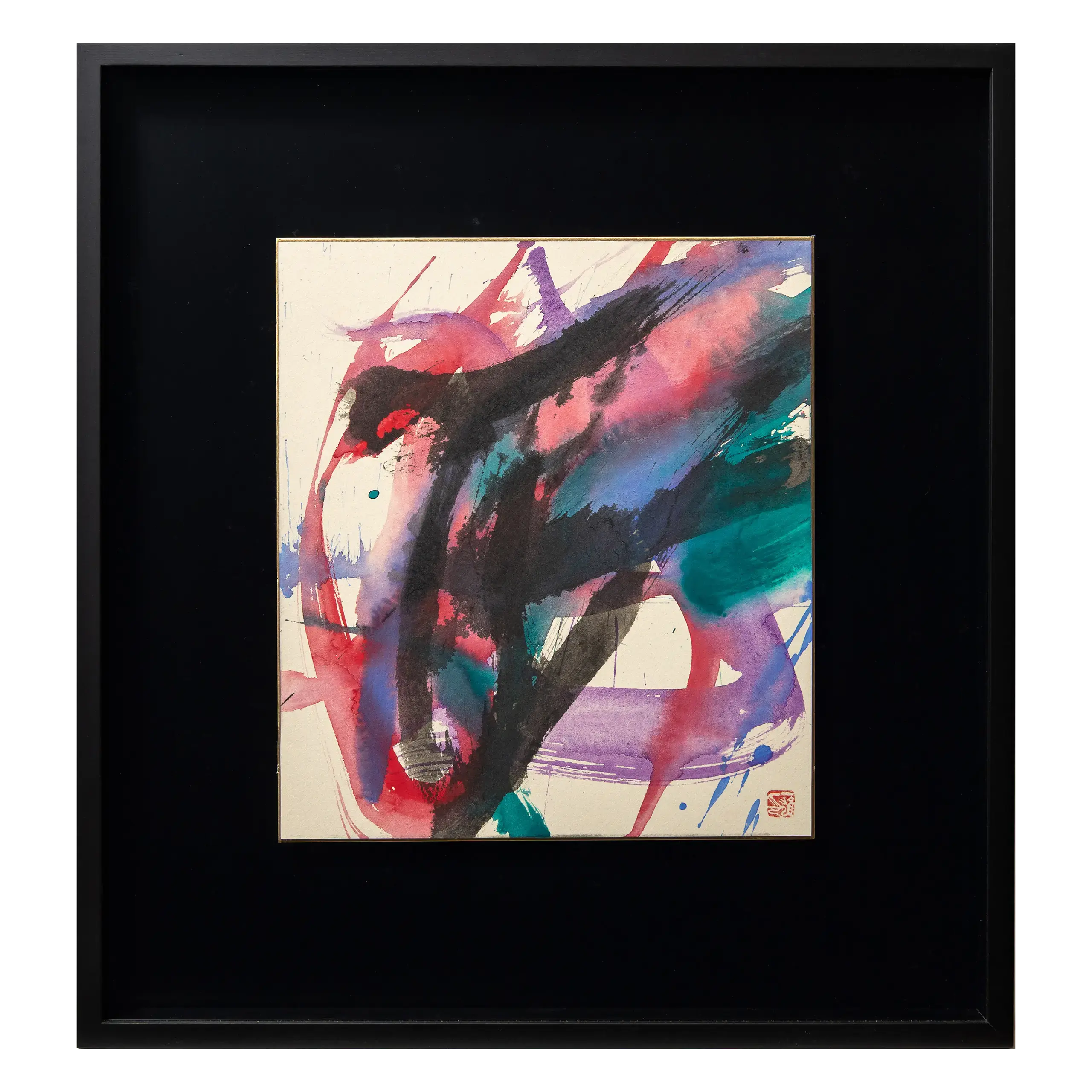
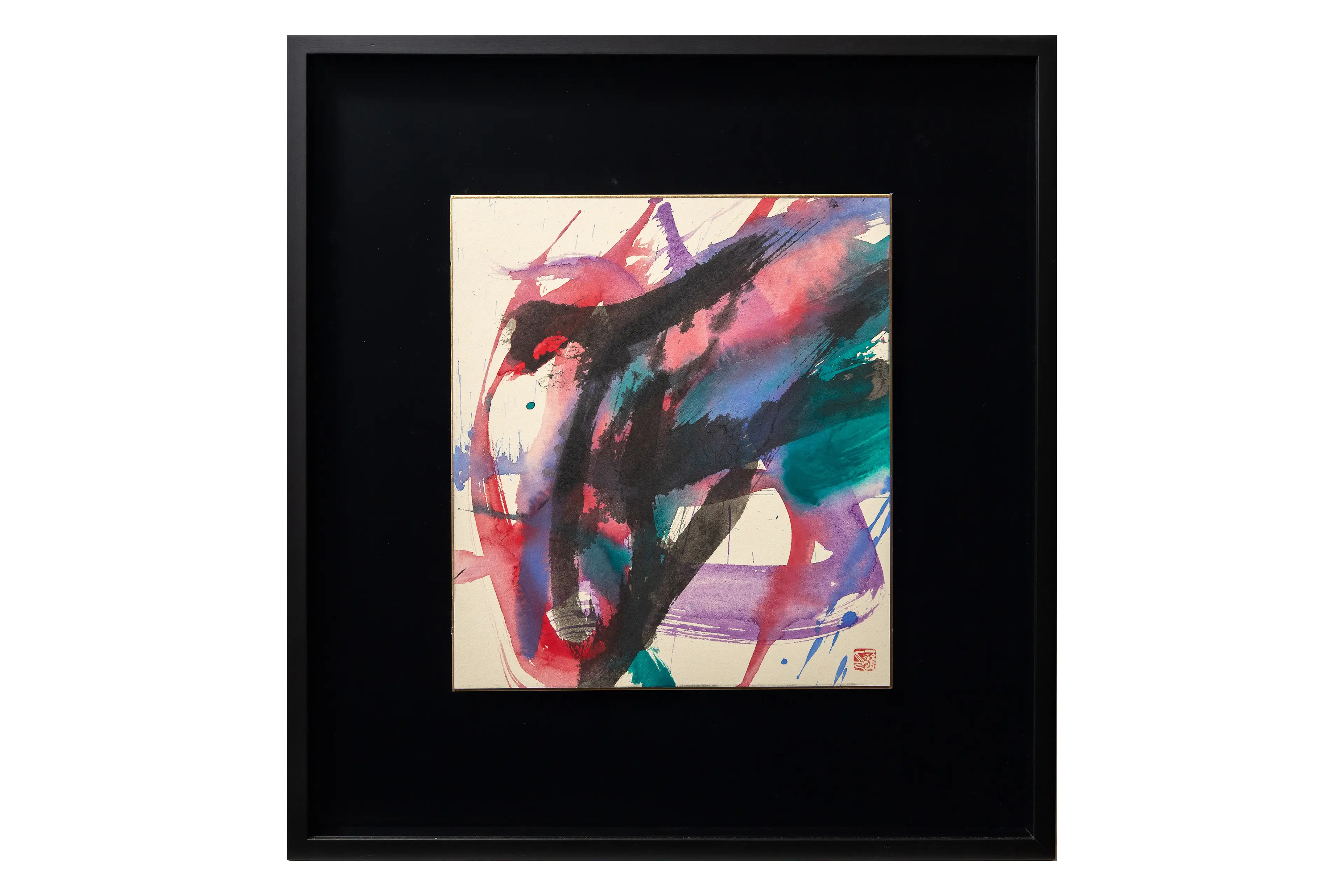
Kazuo SHIRAGA was one of the artists who came to represent the Gutai Art Association (Gutai) and is known as a pioneer of action painting in Japan. His distinctive method—suspending himself from a rope hung from the ceiling, gliding above a canvas spread on the floor, and painting barefoot—left the texture of the paint and the trajectory of his process vividly apparent, producing images filled with force.
Born in 1924 in Amagasaki, Hyogo Prefecture, Shiraga became interested in painting at an early age. He studied Nihonga (traditional Japanese-style painting) at the Kyoto Municipal College of Painting and subsequently turned to Western-style painting. In 1952, pursuing more radical modes of expression, he formed the 0-kai with Saburo MURAKAMI, Atsuko TANAKA, and Akira KANAYAMA. By then he was already painting without brushes, spreading pigment with his feet. In 1955, he joined the Gutai Art Association with those three artists. In addition to foot painting, he attracted attention through performances such as diving into mounds of mud and wrestling in them, and chopping conically assembled logs with an axe.
From the late 1960s onward, Shiraga turned his interest to esoteric Buddhism. In 1971 he was ordained at Enryaku-ji on Mount Hiei. After the Gutai Art Association was dissolved, the deep spirituality he had cultivated through his training became increasingly apparent in his work. During this period he adopted a long squeegee in place of painting with his bare feet, but he later returned to the foot painting that had become synonymous with his practice.
Shiraga's works, imbued with the dynamism of the body and the marks left by his actions, convey an energy that overwhelms viewers and have earned high international acclaim.
As people change over the years, works also develop shifts and changes with age. The works offered at Untitled range from comparatively recent pieces of about twenty years to older works that have passed through nearly seventy years.
Small scratches, changes in the paint surface, shifts in paper or support—these are not mere deterioration but traces of the time the work has lived through.
We do not value only perfect condition. We hope you will receive each work as a single existence, together with the time it has accumulated.
Accessories
Whether a work is framed is noted on each work page. Frame condition varies by work; please contact us in advance if you would like details.
We also accept custom framing matched to the work. As each piece is made individually for the space and work, delivery takes approximately two months.
Framed works include a storage box. Depending on the work, a new box may be made after purchase, which may take several weeks.