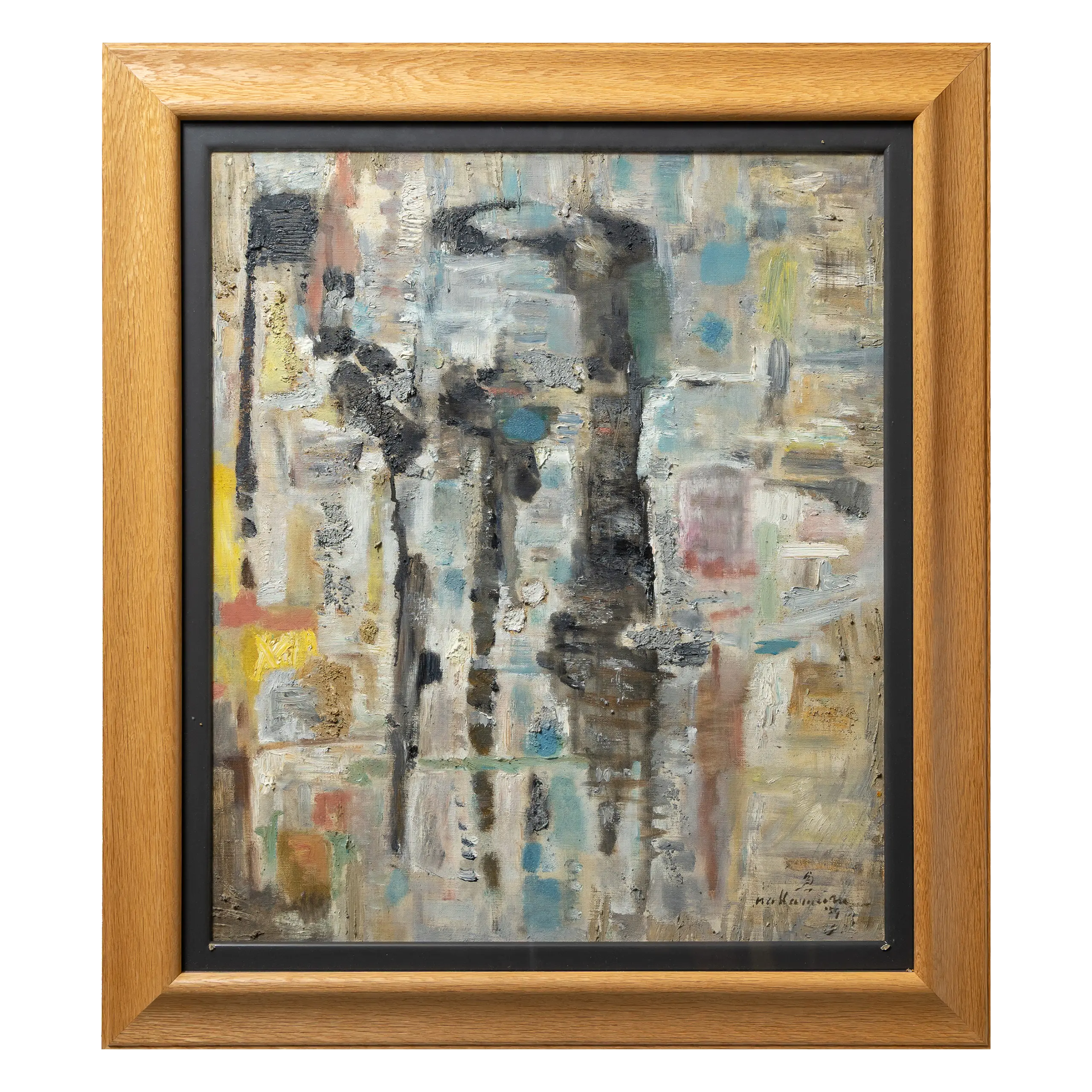
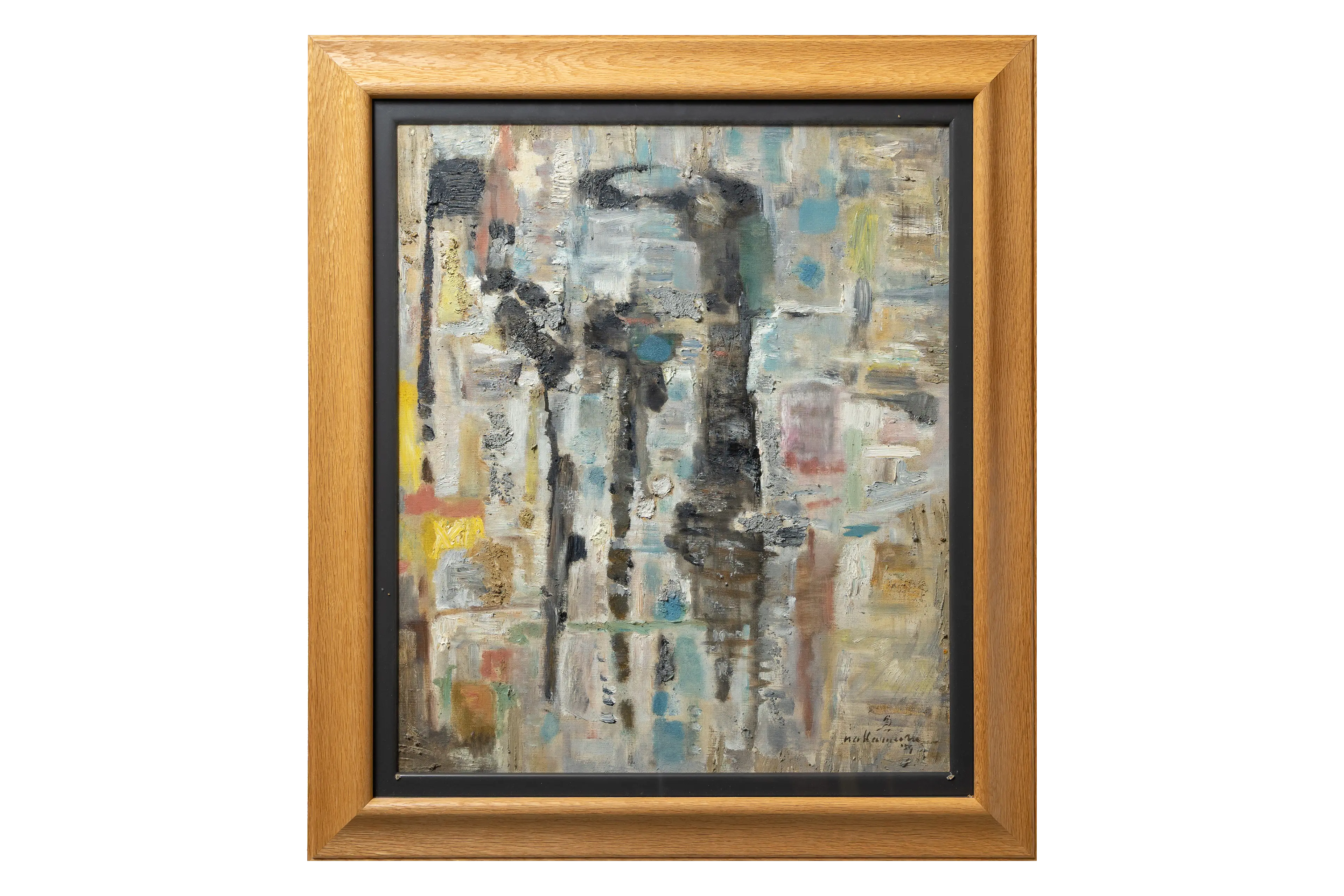
常に新しい美術の動向を捉え、時代の先端を走り続けた中村真(本名・真三郎、1914~1969)は、グラフィックデザイナーの早川良雄(1917~2009)をして「全生涯においてArtとDesignの全き両立と共存のプロトタイプを提示した」と言わしめた画家兼デザイナーです。
大阪市南区日本橋に生まれた中村は小学生の頃から絵の才能を発揮し、1927年より大阪市立工芸学校工芸図案科で学び始め、1928年からは赤松麟作(1878~1953)の画塾でも指導を受けました。在学中には、全関西美術展に入選したことで同協会会員に若くして推薦されなど、天才少年画家として注目を集めます。美術に対する貪欲な好奇心と鋭敏な感性を持っていた中村の作風の変化には、目まぐるしいものがあります。たとえば、赤松の塾に通っていた頃は、その優れた技術でフォーヴィスム的な風景や人物を描いていましたが、1936年あたりからはサルバドール・ダリ(1904~1989)らの影響を受けるようになり、戦後に【太陽と人】(1949年)や【アダムとイヴ】(1951年)といったシュルレアリスム作品を制作しています。このシュルレアリスムからも決別して以降は、鮮やかな色彩のパターンを組み合わせる構成的な純粋抽象が創作の基軸となりました。ただし、このような中村独自の表現の片鱗が窺えるのは、遡って1937年、東京日本サロンにおける個展に出品した【審判】等の作品です。このときの構成的な画面はイギリスの画家、ベン・ニコルソン(1894~1982)を彷彿させ、直線によるシンプルなフォルムとレリーフ状に盛り上がった彩色といった特徴が見られました。そこから数年をかけてこの様式を発展させるなかで、円弧と直線を用いた明快な画風を構築しています。このような合理的な構成力や幾何学的なフォルムなど、知的で純粋な抽象表現への志向は、生涯を通じて中村の芸術観の根底に流れていたと考えられています。
中村の多彩な画業において特に注目すべき作品に、高島屋の個展で発表した【やまとの流れ】(1959年)が挙げられます。地味な色調と荒い筆致による不定形なフォルムで構成された本作は、単なる日本の風景描写ではなく、日本特有の美意識を感じさせる土着的な魅力に満ちており、それまでの構成的な純粋抽象とは明らかに異なる様相を呈しています。この作品以降は再び元の方向性へと戻りますが、色彩は鮮麗さを増し、フォルムもより単純明快になっていきます。なにより、画面の枠組みのなかで色彩とフォルムのバランスや対比を練り上げていた以前の創作に対して、1960年代に手がけた作品では、連続的な構図が枠組みの向こうへ広がっていく形式がとられている点に際立った変化が表れています。そして冒頭で述べた通り、中村はデザインの仕事においても、ポスターからインテリア、ディスプレイ、環境デザインでは肥後橋の照明灯など八面六臂の活躍ぶりを披露していました。当時、絵画とデザインを両立する姿勢は極めて異例でしたが、両者と率先して関わることをむしろ現代の作家としての使命であると自覚していた中村が、どちらの分野でも進化を続け、斬新なアイディアを生み出してきたのは必定でしょう。異彩を放ちながらも、いまだ全貌が明らかではない彼の画業については、今後さらなる研究が期待されます。
Nakamura Shin (real name: Shinsaburō, 1914-1969) was a painter and designer who consistently embraced new artistic movements and remained at the cutting edge of his era. Graphic designer Hayakawa Yoshio (1917-2009) once lauded Nakamura, saying he “presented a prototype of the complete coexistence and harmony of Art and Design throughout his entire life.”
Born in Nipponbashi, Minami Ward, Osaka City, Nakamura’s artistic talent was evident from his primary school years. He began his formal training in 1927 at the Design Department of the Osaka Municipal School of Arts and Crafts. Starting in 1928, he also took lessons at the painting studio of Rinsaku Akamatsu (1878-1953). During his student years, he gained recognition as a prodigiously gifted young painter, most notably being selected for and recommended for membership in the All Kansai Art Exhibition Association at a young age. Nakamura possessed a keen sensibility and a voracious curiosity for art, which led to a remarkably rapid evolution in his style. For example, while studying with Akamatsu, he utilized his superb technique to paint Fauvist-inspired landscapes and figures.
Around 1936, however, he began to draw influence from artists like Salvador Dalí (1904-1989), leading to Surrealist works after the war, such as Sun and Man (1949) and Adam and Eve (1951). Yet, after moving beyond Surrealism as well, his creative focus shifted to a purely abstract, compositional style that combined vivid color patterns. However, glimpses of Nakamura’s unique expression can be seen as early as 1937 in works like The Judgement, exhibited at his solo show at the Tokyo Nippon Salon. The compositional approach here echoed the British painter Ben Nicholson (1894-1982), featuring simple forms defined by straight lines and relief-like, raised color applications. Over the subsequent years, he further refined this approach, constructing a distinct painting style characterized by arcs and straight lines. This rational compositional power and preference for geometric forms-reflecting an aspiration towards an intellectual and pure abstract expression—are considered the constant foundation of Nakamura’s artistic vision throughout his career.
Among Nakamura’s diverse artistic output, a particularly noteworthy piece is Yamato no Nagare (The Flow of Yamato, 1959), presented at his solo exhibition at Takashimaya. Composed of amorphous forms rendered in subdued tones and coarse brushwork, this work does more than merely depict Japanese landscapes. It brims with an indigenous charm that evokes Japan’s unique aesthetic sensibility, presenting a distinctly different facet from his earlier, purely abstract compositions. While his subsequent works returned to his original direction, the colors became more vibrant and the forms increasingly simple and clear.
Crucially, a striking change emerged in the works he produced in the 1960s: whereas his earlier creations had refined the balance and contrast of color and form within the picture frame, these new works adopted a form where continuous compositions expanded beyond the frame.
Furthermore, as noted initially, Nakamura was remarkably versatile in his design work, showcasing his multifaceted talents across posters, interiors, displays, and environmental design, including the lighting fixtures for Higo Bridge. At the time, maintaining a career in both painting and design was highly unusual. Yet Nakamura consciously viewed active engagement in both as his mission as a contemporary artist, which inevitably drove him to continually evolve and generate innovative ideas in both fields. His artistic career, which shone with such distinction yet remains not fully understood, absolutely warrants further research.