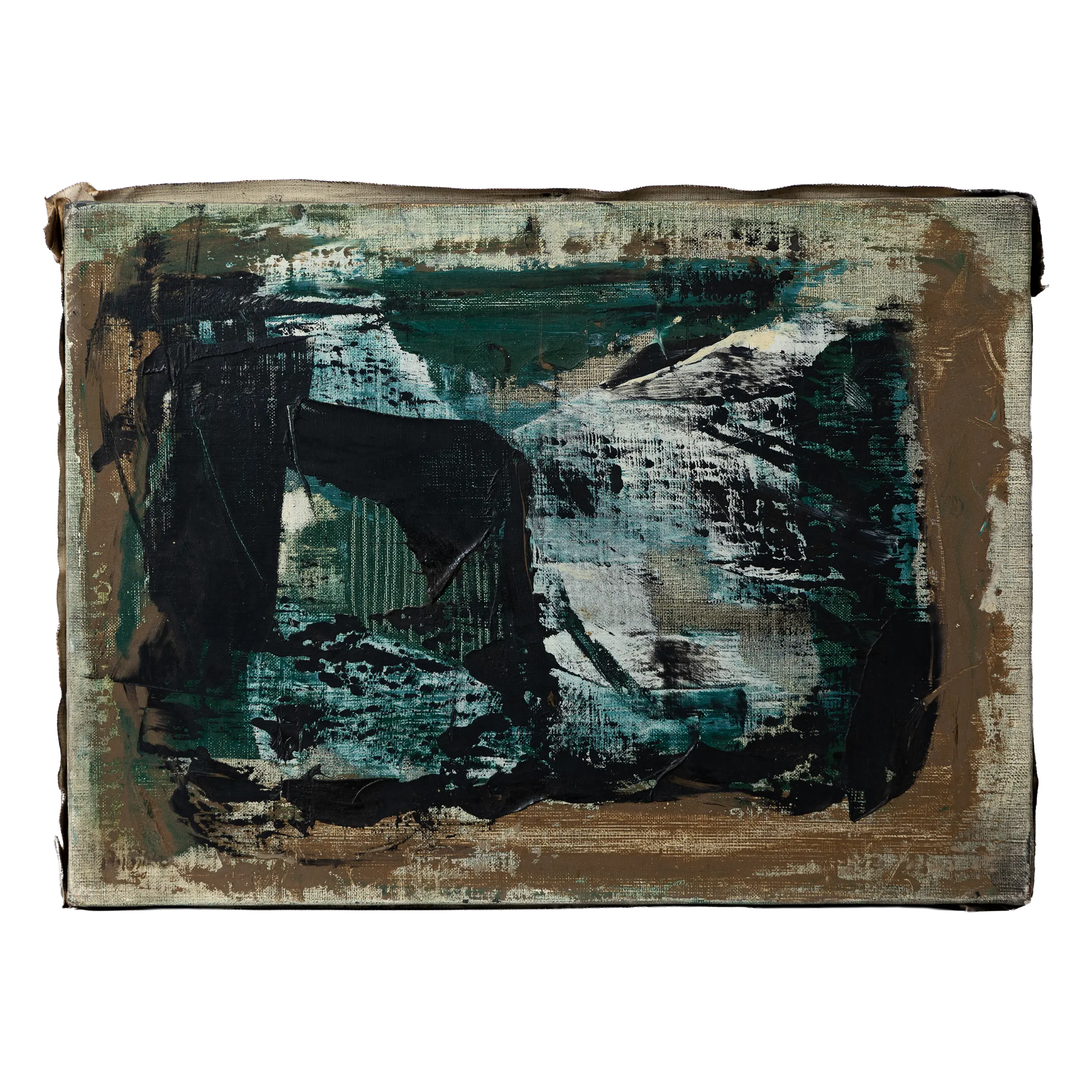
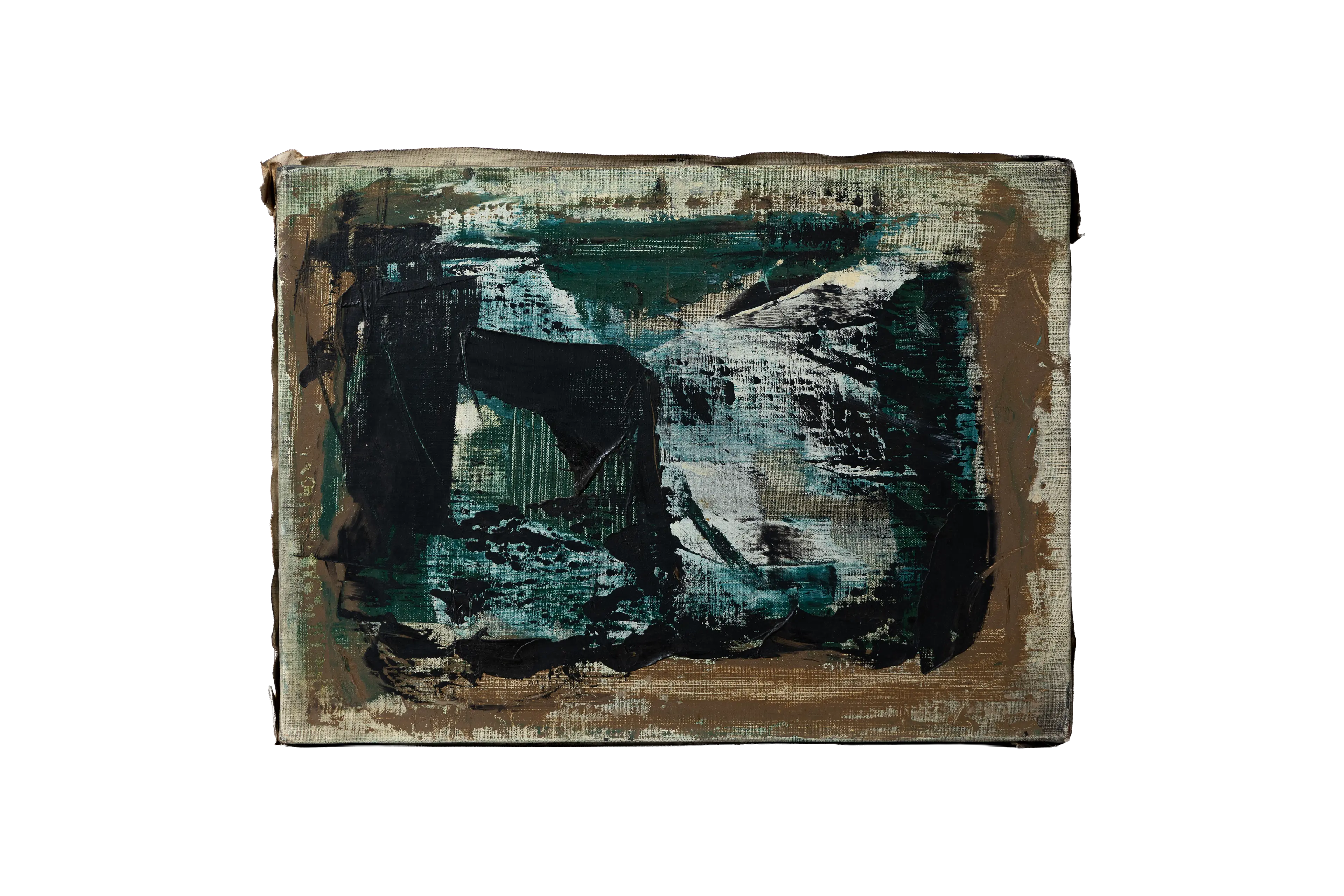
河端亮治(1923~1989)は、大阪市生まれの抽象画家です。
行動美術協会の会員だった河端は、主に行動展とGe展への出品を通して、抽象表現の可能性を模索しました。1959年に制作された【壁】のあと、絵の具を重く塗りこめる傾向がしばらく続きますが、1970年代半ばからはカンヴァスに金属の鋲を打ったものなど、ペインティングから離れた創作に移行しました。1980年代前半は、木枠に薄いガーゼを張り、半透明の画面を展開した「ペール」シリーズ、1986年からは、木枠で囲ったパネルにウレタン樹脂を張り、ミラーの欠片をくっつけるなどした「サイン」シリーズなど、様々な素材、造形への挑戦が窺えます。
河端の名前や作品は、美術雑誌においても定期的に言及されています。たとえば、1959年10月号の『みづゑ』における、美術評論家の柳亮(1903~1978)と針生一郎(1925~2010)の対談では、行動美術展の出品作が取りあげられた際「田中稔之とか長谷川晶とか、河端亮治とかこういうところは受賞作品として妥当なものでしょう」(柳)との評価を受けています。また、河端の作品については「やはりにじみだの、ぼかしを使ってね。ああいうなにか植物的なものをやってはいますからね。あれも1つの傾向だと思うな」「なにかエネルギーはありますよ。僕はだいたい岡田謙三、山口薫の傾向をいくと思うのだな」(いずれも針生)といった批評も加えられました。同年に出版された『三彩』10月号では河端の【歴】が「新しい可能性の芽ばえ」がある作品として挙げられたほか、『アトリエ』11月号でも、「河端亮治、長谷川晶、阿部平臣……といった具合に、有望な新人たちがかなり目につく」と語られているように、新進気鋭の作家として注目を集めていることが窺えます。美術評論家の土方定一(1904~1980)は1960年9月15日の毎日新聞の紙面で、行動美術展で好感を持った作品として、抽象画家の津高和一(1911~1995)や長谷川晶(1925~2005)と並んで河端を取り上げ、「日本的な抒情的色感をもった豊かな構成は、未知な作家だけに新鮮な印象をうけた」と評しました。1962年の記事では、河端の「明るい色彩感覚の画面」を楽しんだとも述べています。
その一方、1960年代半ば以降は、それまで構築してきたスタイルから脱却しようともがく様子が垣間見えます。『美術手帖』の1965年8月号に掲載された展覧会の論評では、「白い画面のなかに吸いこまれるような、あえかな感覚の翳りをにじませたこれまでの作品に比べて、近作はそうしたそうした空間をたち切るように明快な形体をうちだしてきて、その展開ぶりが注目されたが、その形体の表われ方があまりに即興的、浮動的に過ぎ、脈絡を欠いて一貫した訴えに乏しい」と指摘されました。『日本美術工芸』の1965年7月号では、「あまりにも無造作に、かつ造型の労働を飛びこえて、存在を求めるきらいがある」とも表現されています。自分の内側から生まれたイメージやフォルムを洗練し、画面内に適切に位置づけることに苦戦しながら、それでも自身の感性に従い、新たな表現を求めてやまなかった河端の創作活動が、変転を繰り返しながらその後も息長く続いていったのは先述の通りです。
Ryoji Kawabata (1923–1989) was an abstract painter born in Osaka. As a member of the Action Art Association, he explored the possibilities of abstraction primarily through the Action and Ge Exhibitions. Following his 1959 work Wall, Kawabata initially favoured an impasto technique. However, by the mid-1970s, his practice shifted away from traditional painting toward material-focused works, such as canvases embedded with metal tacks. In the early 1980s, his "Pale" series utilised thin gauze stretched over wooden frames to create semi-transparent surfaces. From 1986, his "Sign" series incorporated urethane resin and mirror fragments on wood-enclosed panels, reflecting his continuous experimentation with diverse materials and forms.
Kawabata’s work was a frequent subject of critical discourse. In a dialogue between critics Ryo Yanagi (1903–1978) and Ichiro Hariu (1925–2010) in the October 1959 issue of Mizue, Yanagi noted that works by Toshiyuki Tanaka, Akira Hasegawa, and Ryoji Kawabata were "appropriate as award-winning pieces." Discussing Kawabata’s style, Hariu remarked, "He does use blurring and smudging... He is working on something rather botanical; I think that is one trend," adding, "There is certainly energy there. I believe he follows the lineage of Kenzo Okada and Kaoru Yamaguchi." That same year, the October issue of Sansai cited Kawabata’s Rekki as showing "the budding of new possibilities," while the November issue of Atelier identified him as a prominent newcomer alongside Hasegawa and Taira Abe. In the September 15, 1960, edition of the Mainichi Shimbun, Teiichi Hijikata (1904–1980) praised Kawabata alongside Waichi Tsutaka and Akira Hasegawa, stating: "His rich compositions, imbued with a Japanese lyricism, made a fresh impression precisely because he was an unknown artist." By 1962, Hijikata further commended Kawabata’s "canvases with a bright sense of colour."
Conversely, from the mid-1960s, Kawabata appeared to struggle with outgrowing his established style. An exhibition review in the August 1965 issue of Bijutsu Techo observed that while his earlier works possessed an "ethereal shadow" that drew the viewer into the white canvas, his newer works featured "clear forms as if cutting through that space." However, the critic argued these forms were "too improvisational and ephemeral, lacking context and a consistent message." Similarly, the July 1965 issue of Nihon Bijutsu Kōgei critiqued a "tendency to seek existence in a manner that is far too haphazard, bypassing the labour of form-making." Despite these challenges in refining his internal imagery and its placement within the pictorial plane, Kawabata remained dedicated to his sensibilities, undergoing repeated transformations in his ceaseless pursuit of new expression.