有方敏郎(1922~)は、兵庫県出身の画家です。
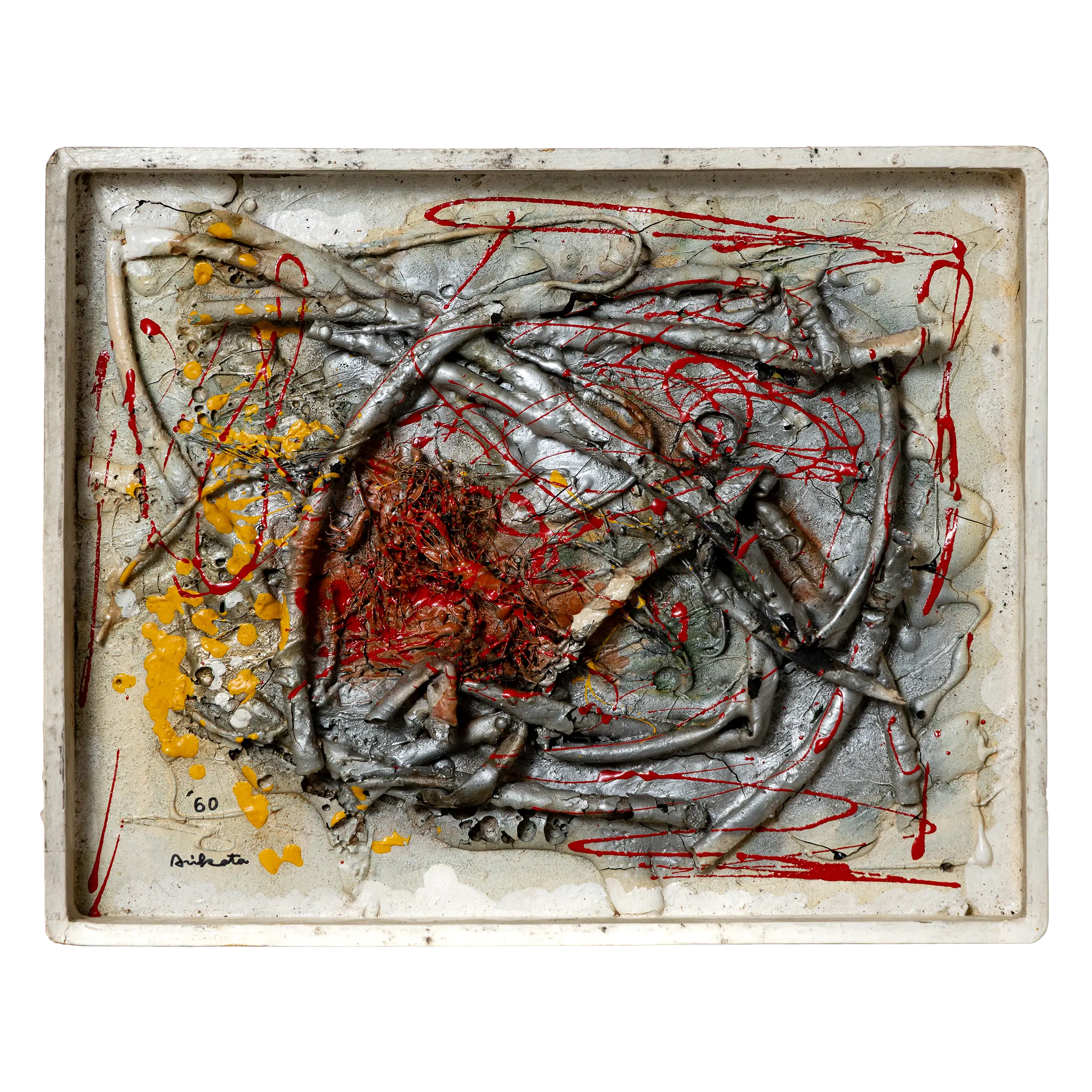
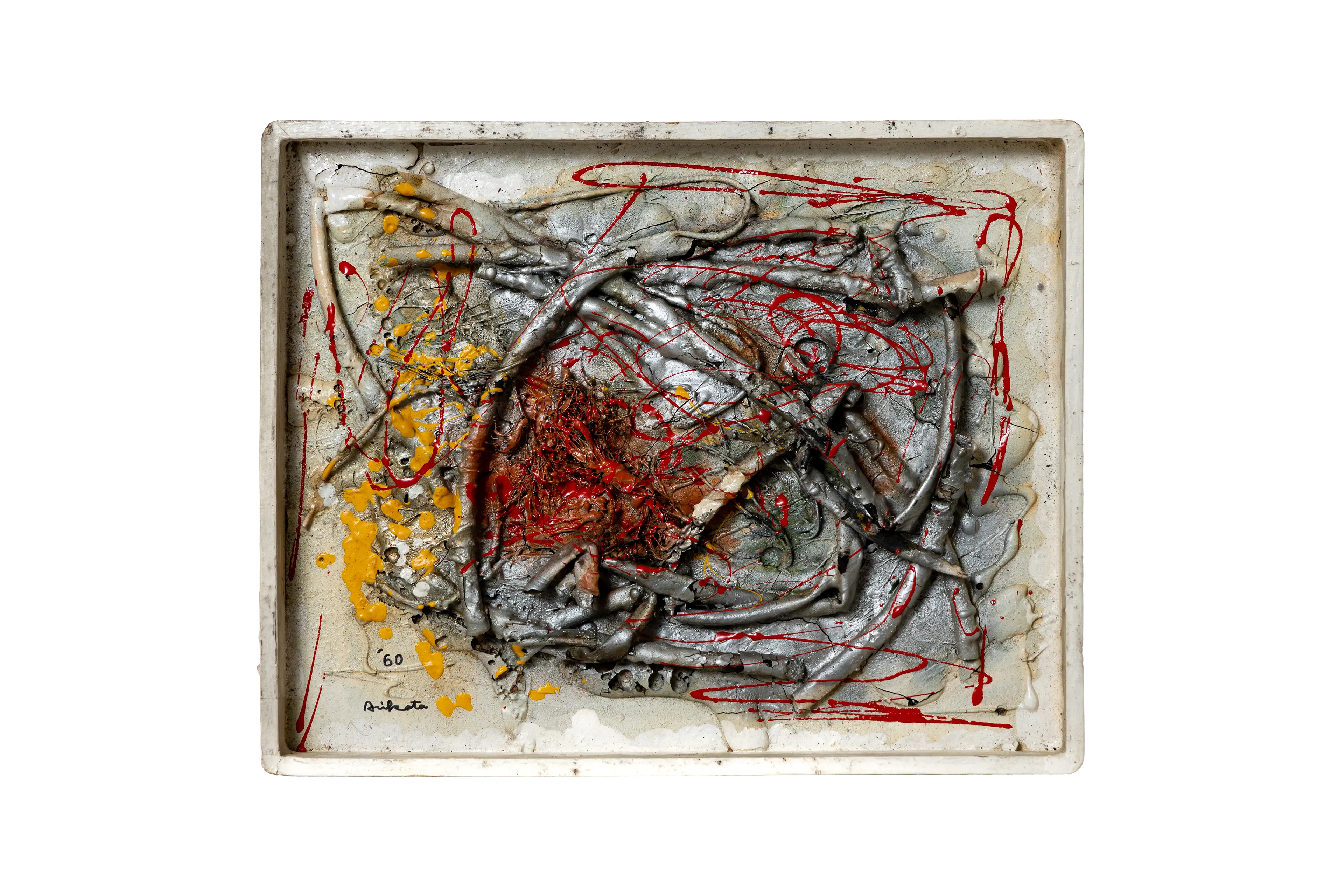
「具体美術家協会(以下、「具体」)」の正式な会員ではなかったものの、創設者の吉原治良(1905~1972)に師事し、具体美術展には第8回~第10回、第16回~第17回に出品していた記録が残っていることから、作品評などでメンバーとして語られることも少なくありません。第10回展にて発表していた作品は抽象画であり、少し褪せた赤、白、黄色、深緑といった色彩が、龍のような、あるいは蛇のような曲線を描き、独特の質感を感じさせる画面が作りこまれています。その他、1960年に丸善画廊で初めて開催した個展についても、『具体資料集 : ドキュメント具体1954-1972』(芦屋市立美術博物館編、芦屋市文化振興財団、1993年)にて記録されています。1977年には、洋画部門で尼崎市民芸術奨励賞を受賞しています。
先述した1960年の個展については、読売新聞に美術評論家の中原佑介(1931~2011)による展覧会評が貴重な資料として残っています。それによると、有方は電気技師という自身の職業を活かし、銅線やソケットといった電気器具を用いて「放電絵画」なる作品を手がけていたそうです。また、ビニール塗料やエナメルを塗った合板に高電圧をかけ、それによってマチエールを変化させる試みや、熱膨張でねじれたり曲がったりした銅線を使って空間をつくりだすといった実験的な創作が実践されていました。初めての個展ということもあり、中原の評価は「結局あとに残ったのは失敗と火傷と疲労だった」と、なかなか厳しいものでした。そのほか、同年の『美術手帖』に寄せられた別の評論家からも、「新奇な試みから生み出された熱気のようなものが感じられる」一方で、「常識的な造形意識と手先の器用さ」に不満が残るとの指摘を受けています。ただし、「この機械派の作家が、マチエールについては、奇妙に趣味的なところがあり、全体として熱っぽく、しかも、湿潤さのある表現に陥る傾向があるのは解せない」という中原の所感は、単なる批判として受け止めるにはあまりにも示唆に富んでいます。1950年代末には、フランスの美術評論家ミシェル・タピエ(1909~1987)によって、「熱い抽象」とも定義されるアンフォルメルが一大ブームを巻き起こし、海外に輸送しやすい平面作品が制作の中心となりました。一方、60年代前半に入ると、「具体」に加入した第二世代が、これまでの「具体」の流れを汲みつつも、平面を浮き立たせる手法などで新しい画面空間を積極的に創出しました。つまり、有方が個展を開催した1960年はまさしくその狭間にあり、それゆえ、二つの時代の特徴を兼ね備えた可能性があるのです。また、電気器具を使用した造形といえば、「具体」の代表的な作家である田中敦子(1932~2005)が連想されます。
作品に対するまとまった研究はいまだなされておらず、上記も単純な推測の域を超えるものではありません。しかし、会員ではないにもかかわらず「具体」の影響が多分に窺える作風や、その変遷を掘り下げることで、有方敏郎という作家の全体像に加え、周辺の作家や系譜においても新たな一面が見えてくるのではないでしょうか。
Toshiro ARIKATA (b. 1922) is a painter from Hyogo Prefecture.
Although Arikata was not an official member of the Gutai Art Association, or Gutai, he studied under its founder, Jiro Yoshihara (1905–1972). Records show that he exhibited in the 8th through 10th and 16th through 17th Gutai Art Exhibitions, and he is therefore often discussed as a Gutai member in reviews of his work. The work he presented at the 10th exhibition was an abstract painting. Its slightly faded reds, whites, yellows, and deep greens form dragon-like or snake-like curves, creating a carefully constructed surface with a distinctive texture. His first solo exhibition, held at Maruzen Gallery in 1960, is also recorded in "Gutai shiryoshu: Document Gutai 1954–1972" (edited by the Ashiya City Museum of Art and History, Ashiya City Cultural Foundation, 1993). In 1977, he received the Amagasaki Civic Art Encouragement Award in the Western-style painting category.
A review of the 1960 solo exhibition by the art critic Yusuke Nakahara (1931–2011), published in the Yomiuri Shimbun, remains a valuable document. According to the review, Arikata made use of his profession as an electrical engineer to create works he called "discharge paintings," using electrical devices such as copper wire and sockets. He also experimented with applying high voltage to plywood coated with vinyl paint or enamel in order to alter its matière, and with creating space through copper wires twisted or bent by thermal expansion. Since this was his first solo exhibition, Nakahara’s assessment was quite severe: "In the end, what remained were failure, burns, and exhaustion." Another critic writing in Bijutsu Techo the same year noted that the works conveyed "something like the heat generated by a novel experiment," while also expressing dissatisfaction with their "conventional sense of form and manual dexterity." Yet Nakahara’s observation that "it is hard to understand why this machine-oriented artist, in terms of matière, has a strangely tasteful side and tends overall toward an expression that is feverish yet humid" is too suggestive to be received as mere criticism. In the late 1950s, Art Informel, defined by the French art critic Michel Tapié (1909–1987) as a form of "hot abstraction," became a major movement, and easily transportable two-dimensional works came to occupy the center of artistic production. In the early 1960s, meanwhile, the second generation of artists who joined Gutai actively created new pictorial spaces through methods that made the picture plane stand out, while still drawing on the earlier development of Gutai. In other words, 1960, the year Arikata held his solo exhibition, fell precisely between these two moments, and his work may therefore have combined characteristics of both periods. When considering the use of electrical devices in art, one is also reminded of Atsuko Tanaka (1932–2005), one of Gutai’s representative artists.
No comprehensive study of Arikata’s work has yet been undertaken, and the points above remain no more than hypotheses. Even so, by examining a practice that strongly suggests the influence of Gutai despite Arikata’s non-member status, as well as the transitions within that practice, it may be possible to see not only a fuller picture of Toshiro Arikata as an artist, but also new aspects of the artists and lineages surrounding Gutai.