オクヤナオミ(本名:奥谷直巳)は、1930年石川県に生まれました 。小松高等学校卒業後、美川海岸で疎開中の宮本三郎と知り合い、それを機に宮本が教鞭を取っていた金沢美術工芸専門学校(現・金沢美術工芸大学)油画科に第一期生として入学しました 。その後も家族ぐるみの付き合いをするなど、宮本との師弟関係は続いていきます。1950年に金沢美術工芸専門学校を卒業。1965年から1982年までフランスのパリに在住し、現地の美術界に触れることでオクヤ自身のコンセプトと感性は磨かれていきます。フランスでは、パリ青年ビエンナーレ展やヨーロッパ各地の国際美術展、版画展に出品し、高い評価を得ています。帰国後は、東京を拠点としながら故郷の石川県などで展覧会や個展を開催しました。パリでも東京でも骨董市に好んで足を運んでいました。著書に『対角線上の異邦人:ヒトデ方陣とアダム方陣』、『余白は芸術に関係がない―が、ひとつのフォルムである』があります。
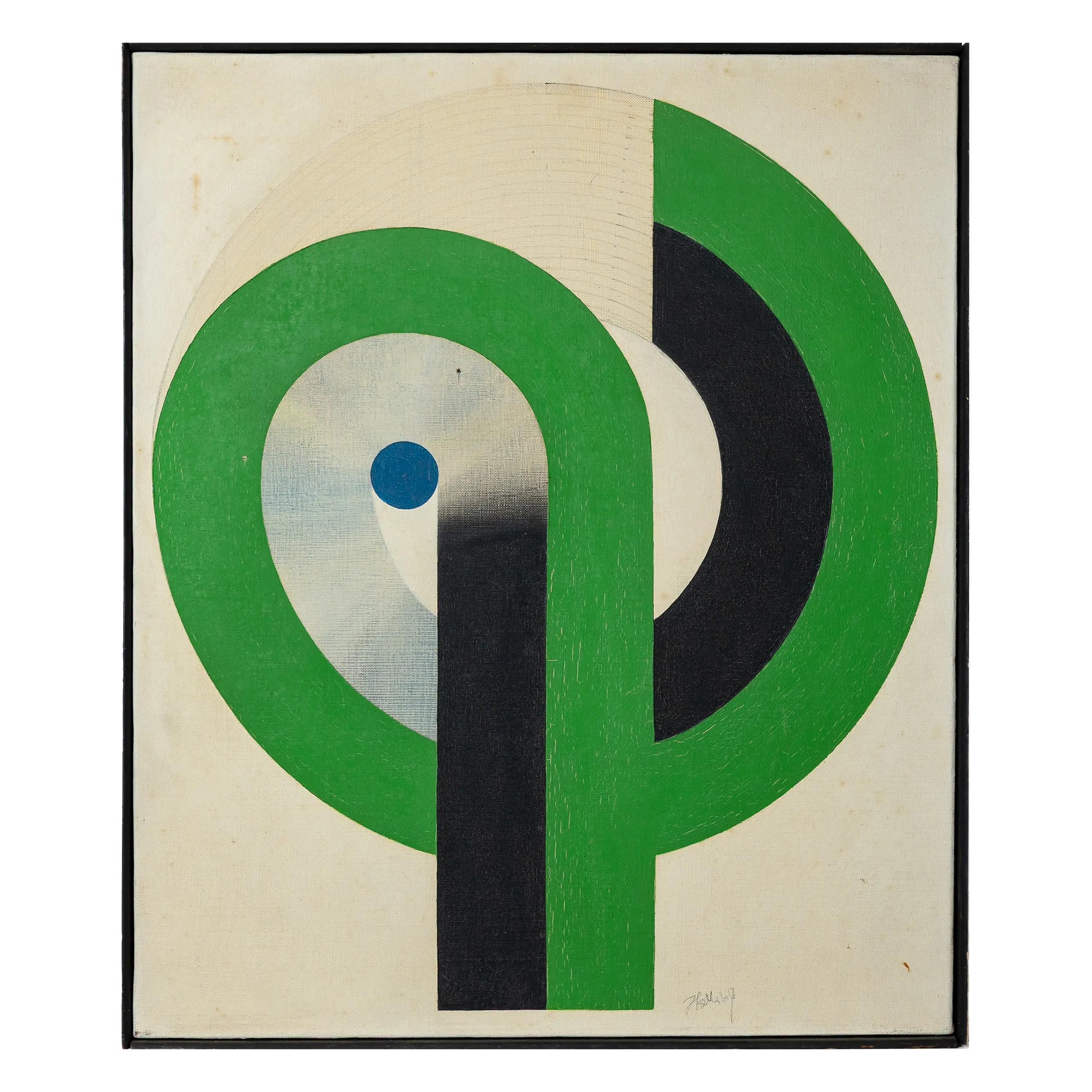
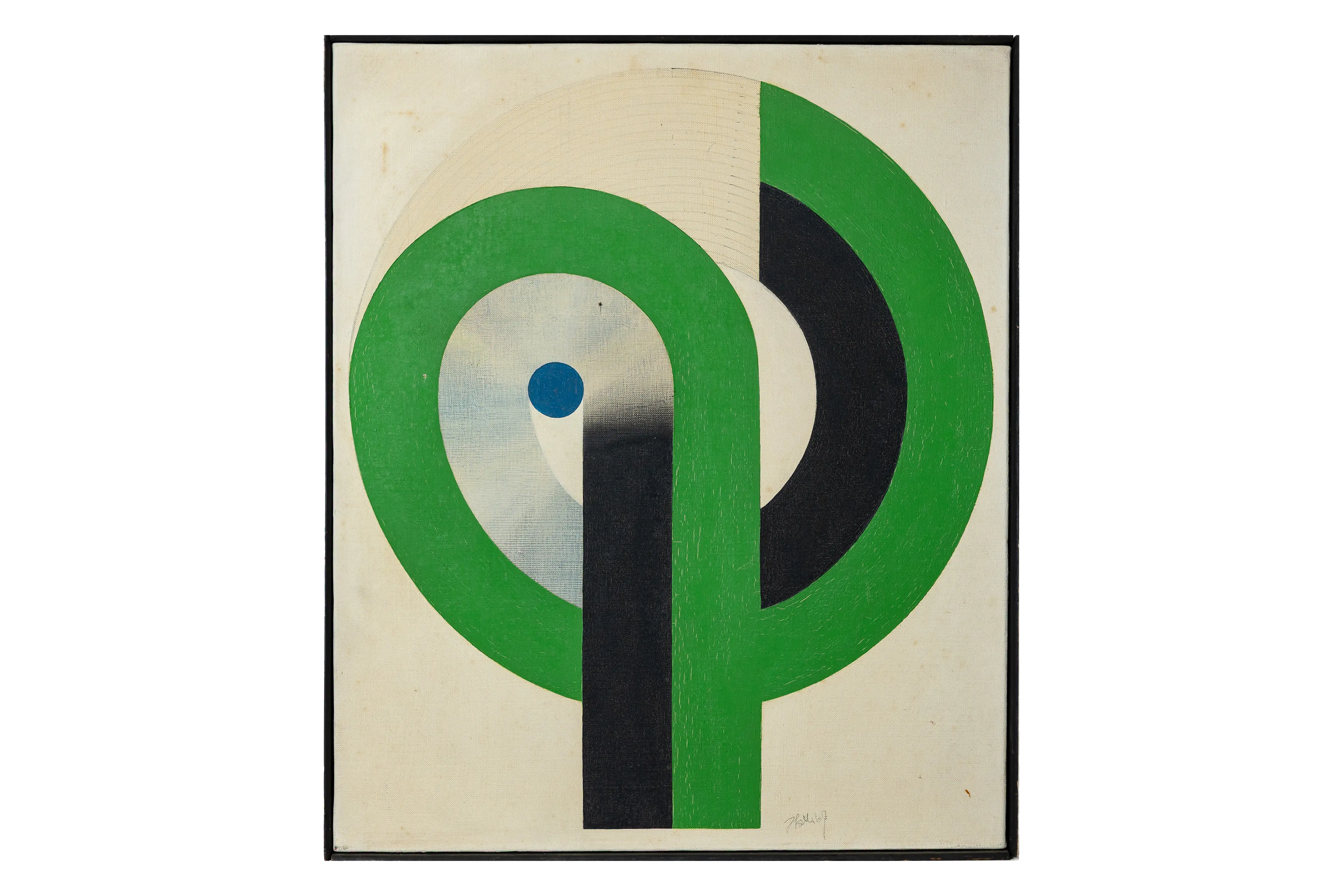
オクヤナオミは、数学的な要素を視覚化する抽象表現を追求してきました。主な技法としてアクリル絵具を用い、平滑かつ単純化された幾何学的形体を描き出します。独自のルール(方陣)を持ち、平面において図形を立体的に浮かび上がらせ、時には図形に動きを見て取れる表現を用いました。また、ひとつのモチーフを上下や左右あるいは対角線上で対照的に、しばしば反転させて配置することも特徴として挙げられます。
「極点の軌跡(1970年)」では、キャンバスに沿って四方形を描いた黒い線が、次の周回では速度を上げて三角形となって内側へ向かっていき、再び始点に戻るような無限ループを生み出しています。極点さえ動き続ける、万物の流転や輪廻を想起させます。
他の作品でも、メビウスの輪や永続的に循環するイメージを持つモチーフが多用されていて、そのような幾何学的モチーフを際立たせるために、余白も大きな存在感を放ちます。オクヤは余白を何も描かれないスペースではなく、フォルムとして捉えていました。帰国後には、既成概念に囚われずに新しい表現を目指した歴史上の芸術家たちへのオマージュ的作品も発表しています。
Naomi Okuya was born in Ishikawa Prefecture in 1930. After graduating from Komatsu High School, a pivotal meeting with the artist Saburo Miyamoto—who had been evacuated to the Mikawa coast—led him to enroll as a member of the inaugural class in the Oil Painting Department at the Kanazawa College of Art and Craft (now Kanazawa College of Art), where Miyamoto was then teaching. Their mentor-student bond remained profound throughout their lives, with their families maintaining close ties long after his graduation in 1950.
From 1965 to 1982, Okuya resided in Paris, where his immersion in the French art scene refined his conceptual depth and aesthetic sensibilities. During this period, he garnered significant international acclaim, exhibiting at the Paris Biennale des Jeunes Artistes and various prestigious print and art exhibitions across Europe. Upon returning to Japan, he established a base in Tokyo while continuing to hold major exhibitions and solo shows in his native Ishikawa. A connoisseur of form in all its guises, he found constant inspiration in the antique markets of both Paris and Tokyo. His philosophy was further immortalized in his publications, including Strangers on the Diagonal: The Starfish Array and the Adam Array and White Space Has Nothing to Do with Art—But It Is a Form.
Okuya’s oeuvre is defined by an abstract language that visualizes mathematical elements. His primary technique involves the use of acrylics to render smooth, simplified geometric forms. Employing his own rigorous system of "arrays," he created the illusion of three-dimensional shapes emerging from a two-dimensional plane, often imbuing these forms with a perceived sense of kinetic energy. A hallmark of his work is the calculated placement of motifs—frequently inverted—along vertical, horizontal, or diagonal axes to create a striking contrast.
In Trajectory of the Pole (1970), a black line traces a square along the edge of the canvas, accelerating with each circuit as it transforms into a triangle while moving inward, ultimately forming an infinite loop. This work evokes the transience and cyclical nature of existence, suggesting that even the "pole" is in a state of perpetual motion.
Throughout his career, Okuya frequently utilized motifs such as the Möbius strip and images of eternal circulation. In his compositions, negative space is never merely an empty void; rather, it plays a vital role in highlighting geometric forms, treated as a "form" in its own right. After returning to Japan, he also produced works paying homage to historical artists who, like himself, sought revolutionary modes of expression by transcending conventional boundaries.