大熊峻(1933~2013)は、スペインの風景画などでよく知られている京都市出身の画家です。また、行動美術協会の会員でもあります。
大熊は京都学芸大学(現・京都教育大学)特修美術西洋画科に進学し、行動美術協会の創設者である洋画家の伊谷賢三(1902~1970)から指導を受けました。その師弟関係は厚く、1962年には伊谷とともに中南米とヨーロッパの各地を周遊しています。およそ半年間にも及ぶ長旅のなかで、ユカタン半島のマヤ遺跡、ペルーのクスコやマチュ・ピチュ、スペインのトレドやアンダルシア地方など、様々な土地に足を踏みいれた大熊は、数々の壮大な風景と伊谷の旺盛な創作活動に刺激を受けました。伊谷が特に画趣をそそられたのはクスコの先住民やトレドの風土であり、この時期には多くの代表作が生まれたといいます。また、それを間近で見ていた大熊は伊谷の作品について、それまでの重厚さに華麗さが加わったことを指摘しています。
その後、1979年にもヨーロッパを訪れた大熊は、とりわけスペインの風土に魅了されていきました。『郵政』の1980年7月号の表紙を担当した際には、グラナダのアルバイシンの丘を描いていますが、「真夏を思わす様な明るいすみきった青空の下に真っ白な家とレンガ色の屋根が丘一面に立ち並び、その間をぬう迷路のような小路」は「どこを向いても絵になるところ」であるという作者の言葉の通り、その魅力は洗練された色彩と筆致で表現されています。空、家、丘の山肌といったモチーフには立体的な陰影がなく、平面的な画面になっている点が大きな特徴ですが、これは現地の明るい陽光のきらめきをそのまま表現するためだと考えられます。また、シンプルに構成された建物のなかにも、扉や窓にわずかに原色が取り入れられており、青い空や白い雲、緑樹とあいまって、色の数が少ないながらも鮮やかな絵に仕上がっています。【アンダルシヤ】(1989年)という作品では画面全体がほぼセピア色に覆われていますが、簡潔な線で描かれた樹木と町が重なりあうことで、奥行きのある空間が広がっています。
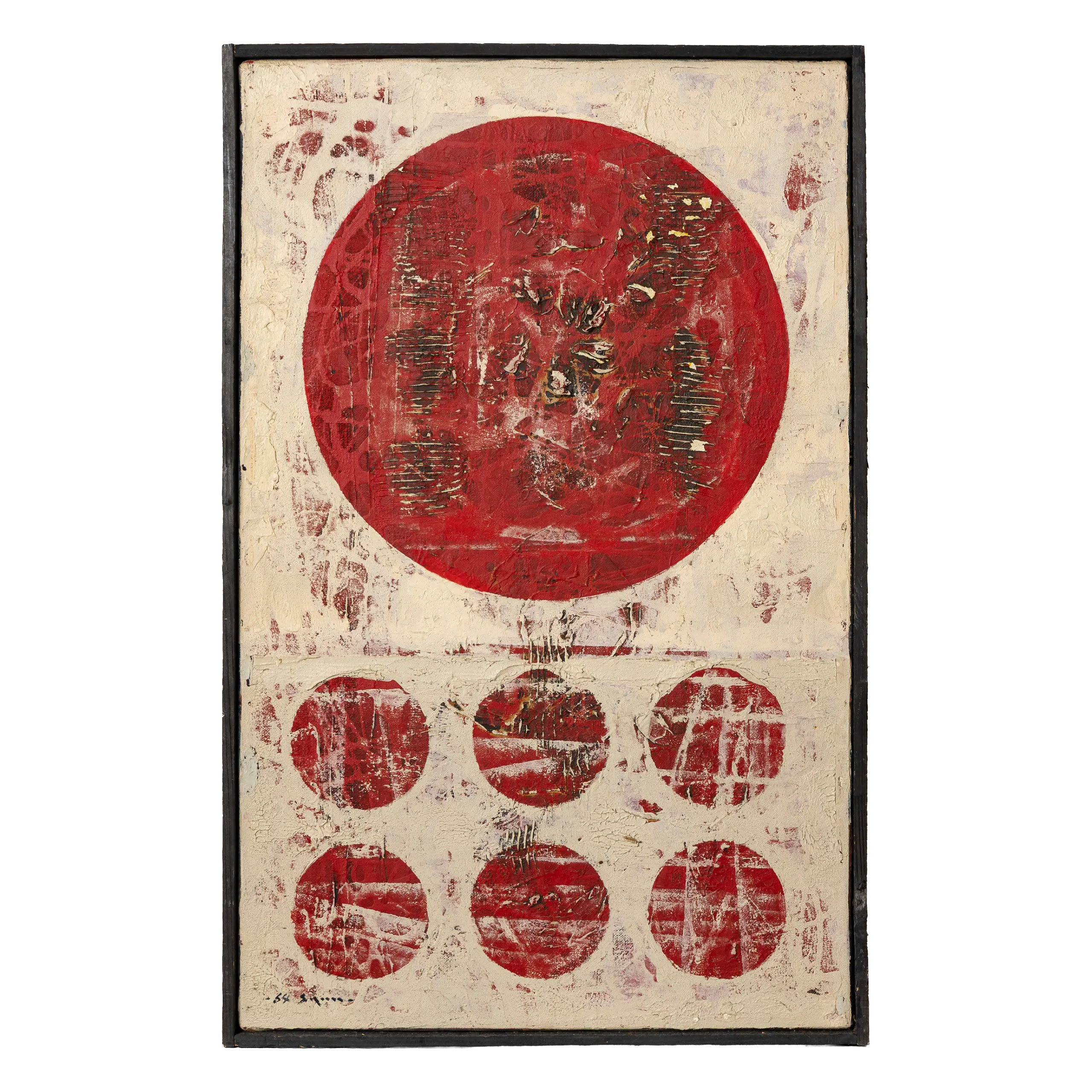
こうした代表作を持つ大熊ですが、実は初期に手がけていたのは抽象画でした。『美術手帖』の1958年7月号に掲載された展覧会の選評では、【スラム】という、短冊のようなフォルムを描いた作品が取りあげられており、「自由に―いかにも闊達な自由さで、自分の仕事をすすめている」姿勢と、「いままでの閉鎖的な不明晰な画面がこんどは一きょ(ママ)に開放的になり、色彩も明るく簡潔で暖色が主調になった」点が指摘されているほか、「遅滞ないのびやかな筆触とフォルムも頼もしく、好感がもてる」と評価されています。
抽象画から風景画への転向に、先述の旅の経験がかかわっていることは言わずもがなですが、風景を写しとったというよりも、風土そのものを画面のなかに押し広げたような生き生きとした描写は、大熊がそれ以前から育んできた独自の表現力とも密接につながっていると考えられます。
Shun Okuma (1933–2013) was a Kyoto-born painter celebrated for his Spanish landscapes and his membership in the Action Art Association. Okuma enrolled in the Specialized Course in Western Painting at Kyoto University of Arts and Sciences (now Kyoto University of Education), where he studied under Kenzo Idani (1902–1970), a prominent Western-style painter and founder of the Action Art Association. Their mentor-student bond was profound; in 1962, Okuma accompanied Idani on an extensive six-month journey through Central and South America and Europe. This formative odyssey took them to the Mayan ruins on the Yucatan Peninsula, Cusco and Machu Picchu in Peru, and Toledo and Andalusia in Spain. Inspired by these majestic landscapes and Idani’s vigorous creative energy, Okuma witnessed a pivotal evolution in his mentor's work. Idani was notably moved by the indigenous people of Cusco and the atmosphere of Toledo—a period that yielded many of his masterpieces. Okuma observed that during this time, Idani’s work acquired a new-found splendor alongside its characteristic gravitas.
Upon returning to Europe in 1979, Okuma became particularly captivated by the Spanish landscape. For the July 1980 cover of Yusei, he depicted the hills of the Albaicín in Granada. He described the scene as one where "under a bright, clear blue sky reminiscent of midsummer, pure white houses and brick-colored roofs line the hillside, with maze-like alleys winding through them." Regarding it as a place where "every direction is a picture," Okuma captured its charm through refined palettes and brushwork. A defining characteristic of this period is the lack of three-dimensional shading in motifs like the sky and houses, resulting in a flat composition intended to directly convey the brilliance of the local sunlight. Even within these simplified structures, subtle primary colors accent doors and windows; combined with the blue sky, white clouds, and green trees, the paintings achieve a vivid effect despite a restrained color palette. In his 1989 work Andalusia, although the canvas is dominated by sepia tones, the overlapping trees and towns rendered in simple lines create a profound sense of depth and expansiveness.
While Okuma is renowned for these landscapes, his career actually began in abstraction. A review in the July 1958 issue of Bijutsu Techo highlighted his work Slum, featuring strip-like forms. The critic praised his "expansive sense of freedom" and noted that his "previously closed and obscure compositions have become open in a single stroke, with colors that are bright, simple, and dominated by warm tones." The review further commended his "unhesitating, fluid brushwork and forms" as both "reassuring and appealing."
It is evident that his early travels facilitated his transition from abstraction to landscape painting. However, his vivid depictions—which seem to expand the very essence of the landscape onto the canvas rather than merely replicating it—are fundamentally linked to the unique expressive power Okuma had cultivated long before his travels began.