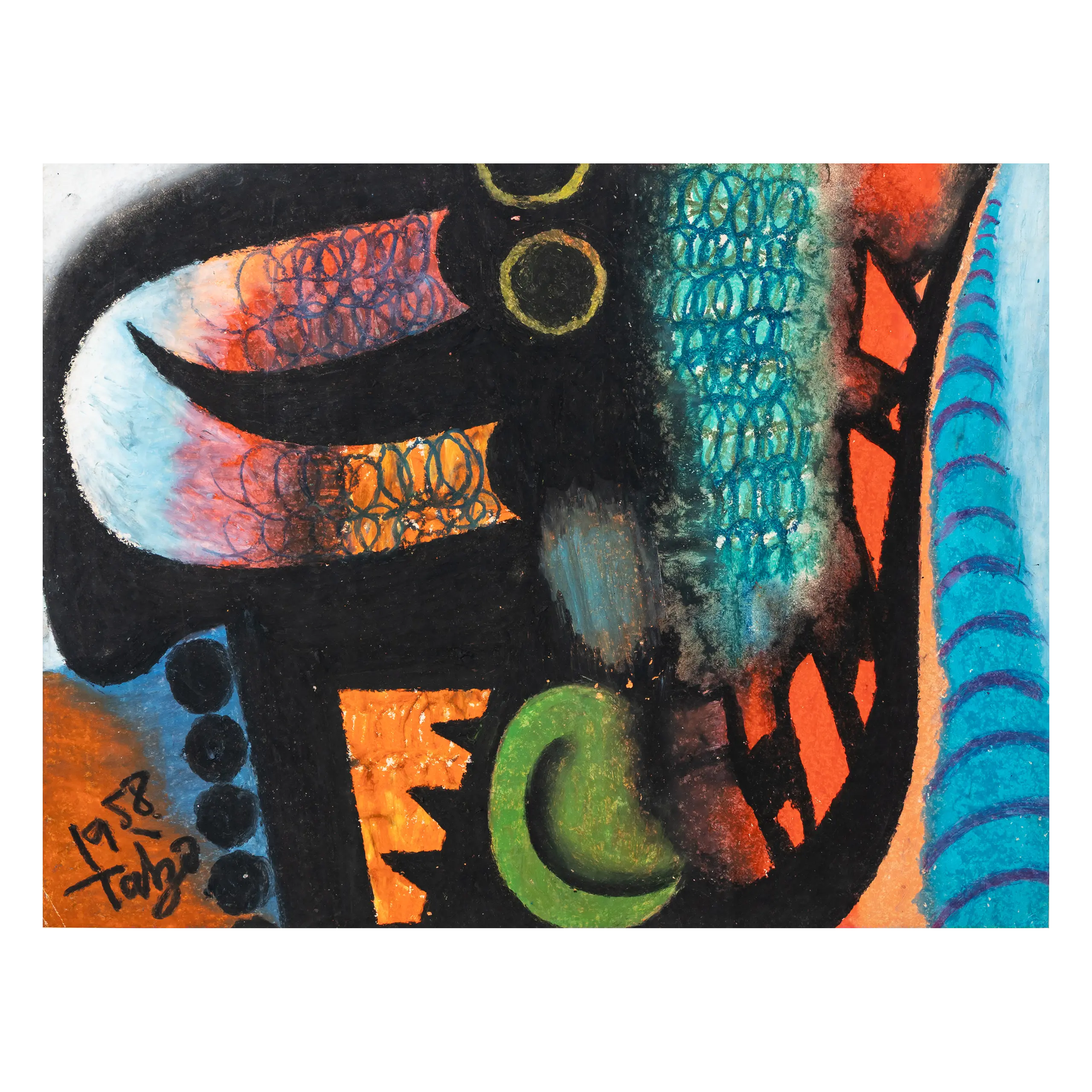
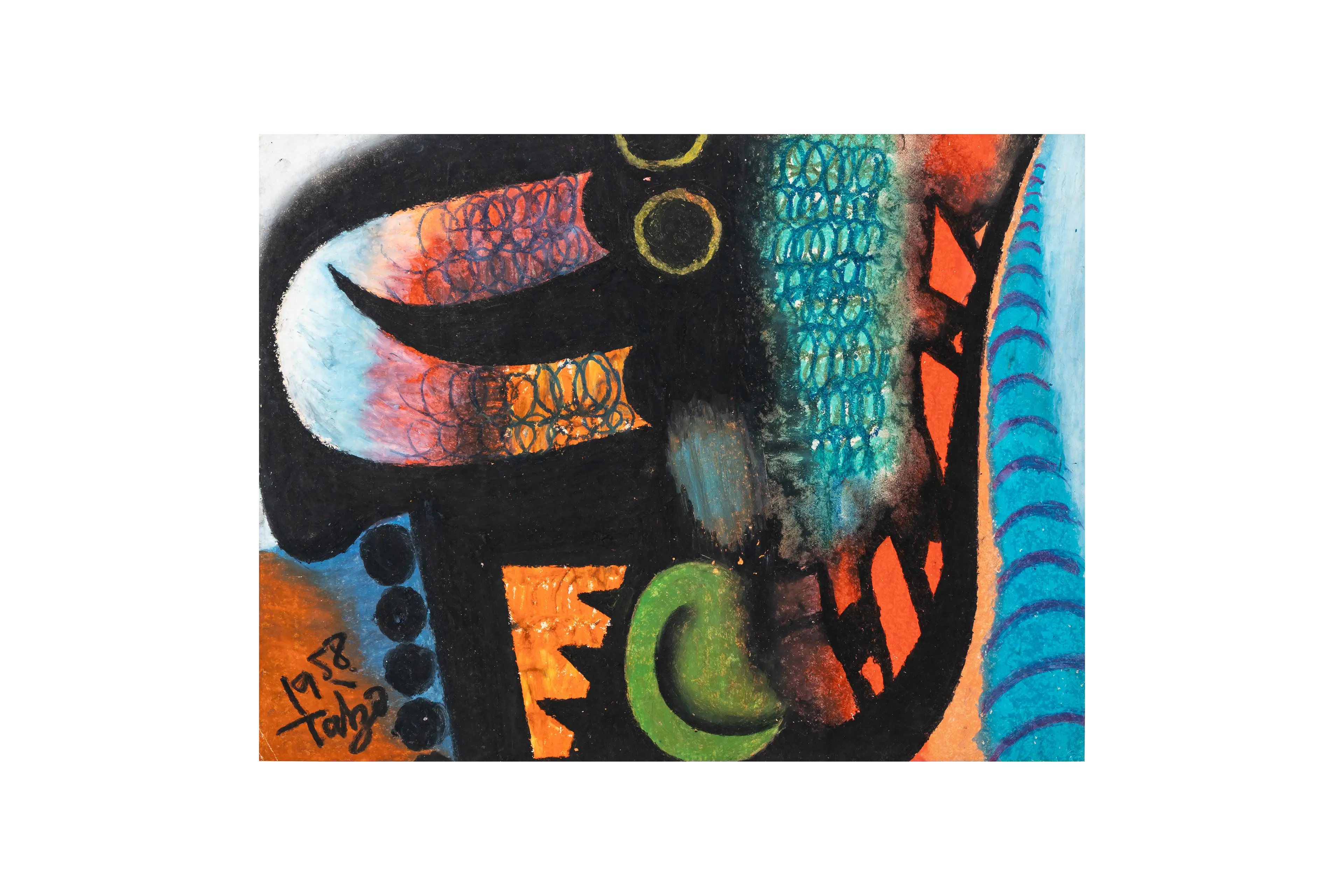
吉仲太造は、1928年京都市に生まれました。小学校卒業後に志した美術学校への進学は、小児麻痺による左足の不自由から不合格となります。しかし友禅や仏師の徒弟を経て、1946年に京都人文学園絵画部(のちの行動美術京都研究所)へ入所。画家として歩み始めました。1952年の上京後、美術評論家・瀧口修造の企画した個展で評価を得たほか、1953年には「行動美術賞」を受賞します。1955年からは岡本太郎の招きで「二科会九室会」に参加し、前衛芸術のうねりの中で制作を行いました。1961年に岡本太郎と共に二科会を退いて以降は、団体に所属せず、画廊での発表を中心とする独自の活動を続けた孤高の画家と言えます。その後、43歳でうつ病を発症。病と闘いながら制作を続けましたが、1985年に肝硬変などのため56歳で急逝しました。没後も美術館での回顧展などを通じ、また大手新聞各社や美術専門誌にて取り上げられるなど、一定の再評価を獲得しています。
1946年から1984年まで制作に専心した吉仲の作風は、時代の動向に反応しながらも独自の探求を続け、生涯で大きく変貌を遂げました。
初期の1950年代は、閉塞感のある抽象的な油彩画を手がけていましたが、岡本太郎の影響を受けてからは、原色を用いた鮮やかな色彩とエネルギッシュかつリズミカルな筆致へと変化しました。60年代に入り、国立近代美術館での「現代美術の実験」展ではボタン、カミソリの刃などをコラージュした作品を展示。なかでも、新聞紙の株式欄と不動産欄のコラージュ作品は、高度成長期の社会状況を映した特異性によって存在感を放ちました。その後、カラフルで写実的なフォトリアリズム風の時期を経て、43歳でうつ病を患います。発病してからは、1975年頃の連作『病と偽薬』に見られるように、無彩色のキャンバスにシルクスクリーンを用いて静物などの映像を浮かび上がらせる手法を試みました。晩年は、白い絵具を主とした「非色の絵画」と呼ばれる、無駄なものを削ぎ落とした静謐な世界観を構築しました。
Taizo Yoshinaka was born in Kyoto in 1928. After completing his primary education, he aspired to enter art school but was denied admission due to a physical disability in his left leg caused by polio. Undeterred, he honed his craft as an apprentice to a Yuzen dyer and a Buddhist sculptor before enrolling in the Painting Department of the Kyoto Humanities Academy (later the Kyoto Institute of Action Art) in 1946, marking the true beginning of his artistic journey.
Upon moving to Tokyo in 1952, Yoshinaka’s talent caught the eye of the influential critic Shuzo Takiguchi, who organized a solo exhibition that brought him into the spotlight. In 1953, he was honored with the "Action Art Prize." By 1955, at the invitation of Taro Okamoto, he joined the "Nika-kai Kyushitsu-kai," positioning himself at the heart of Japan's avant-garde surge. Following his departure from the Nika-kai alongside Okamoto in 1961, Yoshinaka chose the path of a solitary painter. He eschewed group affiliations in favor of independent gallery-based activities, carving out a singular niche in the art world.
At the age of 43, Yoshinaka began a long struggle with depression. Despite the toll of his illness, he remained dedicated to his practice until his sudden passing in 1985 at the age of 56, due to complications from cirrhosis. His legacy has since been revitalized through major museum retrospectives and extensive coverage in prominent newspapers and specialized art journals.
Yoshinaka’s body of work, spanning from 1946 to 1984, is a testament to a life of restless exploration. While sensitive to contemporary trends, his style underwent profound transformations. In the early 1950s, he produced somber, abstract oils characterized by a sense of stagnation. However, under the influence of Taro Okamoto, his palette shifted toward vivid primary hues and energetic, rhythmic brushwork. By the 1960s, he was experimenting with assemblages of everyday objects—buttons and razor blades—at the "Experiments in Contemporary Art" exhibition at the National Museum of Modern Art. His collages of newspaper stock listings and real estate ads notably captured the frantic social climate of Japan’s rapid economic growth.
Following a brief period of colorful photorealism, the onset of his depression marked another stylistic shift. In his 1975 series Illness and Placebos, he utilized silkscreen techniques to pull still-life images onto achromatic canvases. In his final years, he reached a pinnacle of minimalism with his "non-color paintings." These serene, white-dominated works stripped away all superfluous elements, revealing a profound and tranquil worldview.