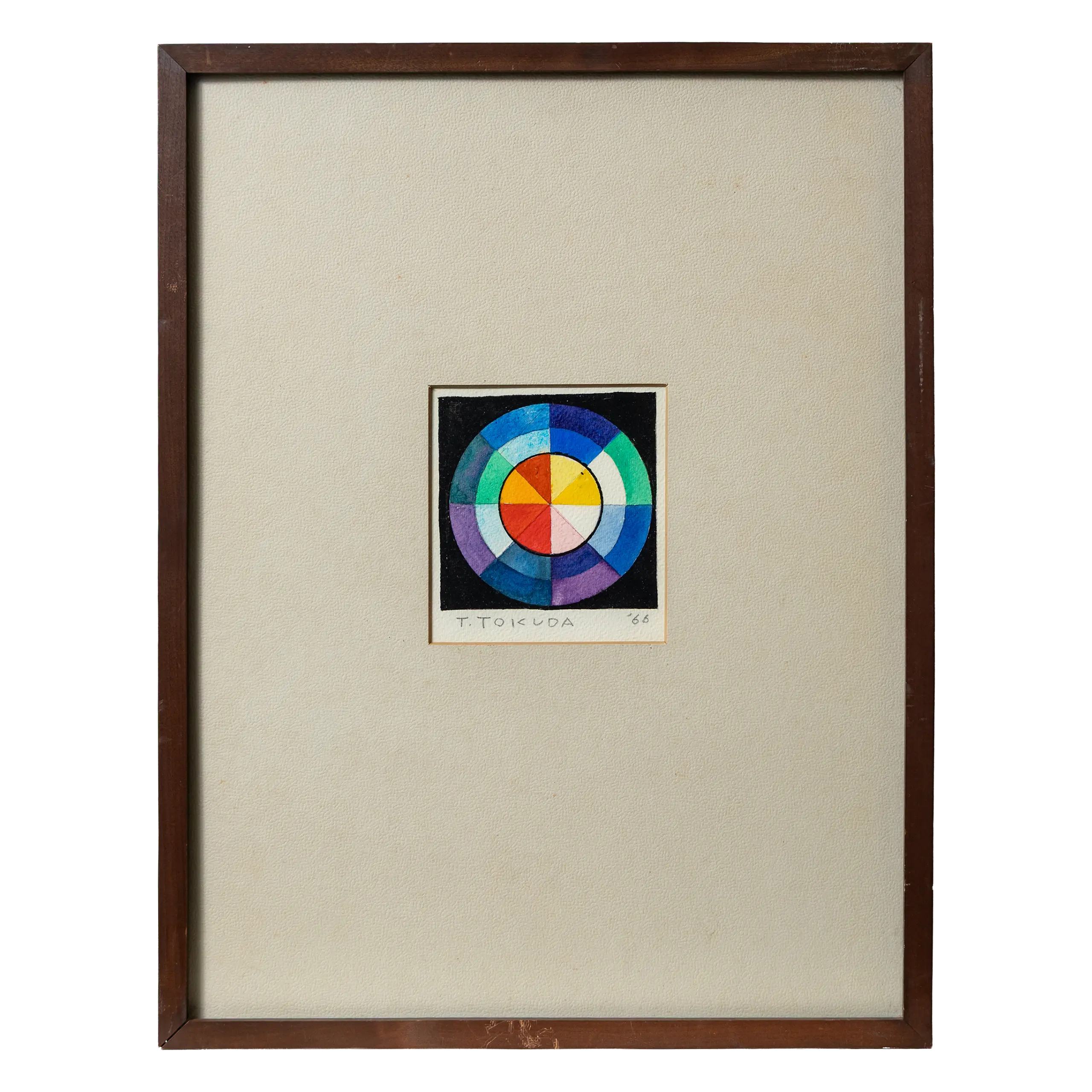
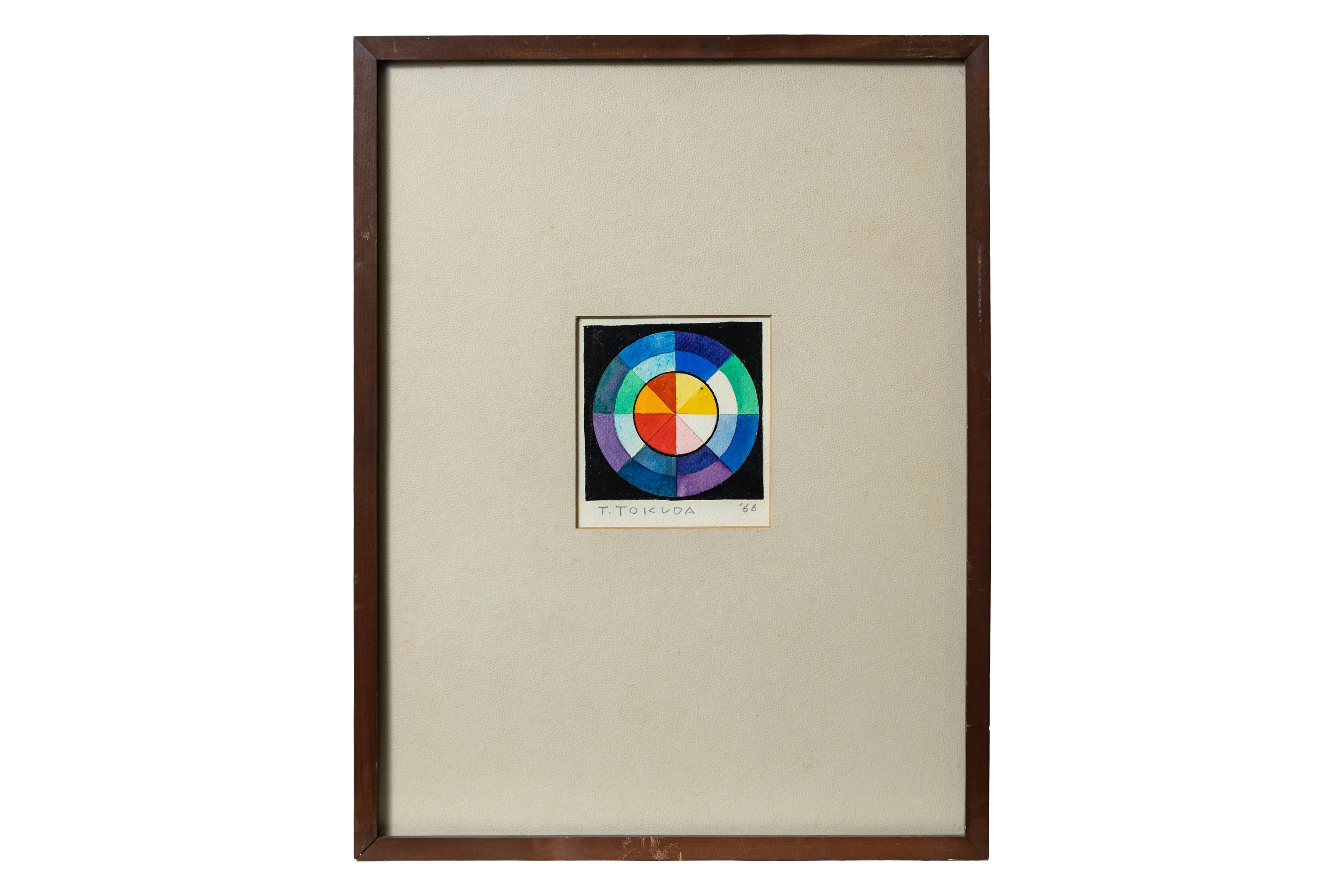
得田壽之(1932~2004)は、神戸生まれの画家です。
1963年に挿画を担当した、小説家の北杜夫(1927~2011)の絵本『ローノとやしがに』でその名前を耳にした人もいるのではないでしょうか。2026年に創刊70周年を迎えた月刊絵本「こどものとも」の一冊ですが、同シリーズでほかにも多くの挿絵を描いています。挿絵画家としてのイメージが強い一方、1966年に戦後20年の日本版画展、1967年に東京国際ビエンナーレ展、1968年に第3回国際芸術見本市・メキシコ展にそれぞれ招待出品、1970年には現代日本の版画展に参加するなど、画家として旺盛な創作活動を展開していました。
絵本の挿絵は具象的であり、異国情緒を感じさせるモチーフや土着的な画風が特徴です。たとえば、先述の『ローノとやしがに』では、南の島の少年ローノと木登り上手なやしがにのユーモラスな攻防が、油絵のように濃く鮮やかな色彩で描写されています。挿絵以外の作品では、シルクスクリーンやリトグラフのほかにパステル画も手掛けていますが、いずれの作品にも抽象的な画面作りが共通しています。『現代美術の断面 日韓80年代中期の現況』(京都国際芸術センター、1989年)にて紹介されているパステル画【街での解逅】(1987年)は、黒字のキャンソン紙に白のパステルで格子柄や曲線を描いたり、矢印や三日月のように見える形象を水色や紫色で彩ったりした抽象的な作品です。同書で一緒に取り上げられている【鳥を呼ぶ風】(1987年)や【二人】(1988年)もパステル画であり、そこに描かれた鳥やキスをする人物たちは大きくデフォルメされています。得田がどのような先人に影響を受けたのか、その具体的な研究はまだ見当たりませんが、上述の抽象作品は、抽象絵画の草分けといわれるワシリー・カンディンスキー(1866~1944)やシュルレアリスムのジョアン・ミロ(1893~1983)、キュビスムのパブロ・ピカソ(1881~1973)といった大家たちを連想させます。また、『太陽を求める向日葵:私たちに影響を与えた友と師 瑛九・北川民次・久保貞次郎・周郷博・宮武辰夫』(島崎清海編、文化書房博文社、1977年)と『瑛九とその仲間たち展』(町田市立国際版画美術館、1988年)には、美術評論家の久保貞次郎(1909~1996)、前衛画家の瑛九(1911~1960)との交流がささやかながら記録されています。前者では、久保から紹介された作家のヘンリー・ミラー(1891~1980)に得田が熱中したこと、後者では、「瑛九の人間や芸術にひかれて、かれの忠告を進んでうけていたひとびと」の一人として得田の名前が挙がっています。
自身の高校時代を振り返る貴重な資料も残っており、美術クラスで取り組んだクロッキーが、後に久保から線の画家と呼ばれる画風の端緒に、生物研究部で「兎の血の鮮やかな紅に魅せられた」ことが、1967年の東京国際版画ビエンナーレで受けた「トクダの色彩は日本人を超えた明快な世界だ」という評価にそれぞれつながっているのではないかと回想しています。子ども向けの美術教室をひらいていたことから教育にも関心を持っていたことが窺われ、今後はその幅広い人間関係や取り組みから彼の活動を掘り下げることも期待されます。
Toshiyuki TOKUDA (1932–2004) was a painter born in Kobe.
Many readers first encountered his name through the picture book Rōno to Yashigani (Rōno and the Coconut Crab, 1963), written by the novelist Yasushi Hoppo (1927–2011). The volume belongs to the monthly picture-book series Kodomo no tomo, which marked its seventieth anniversary in 2026, and TOKUDA illustrated many other titles in the same line. He is strongly associated with illustration, yet as a painter he maintained an active exhibition schedule: invited showings at the Japanese Print Exhibition marking twenty years after the war (1966), the Tokyo International Biennale of Art (1967), the Third International Art Fair in Mexico (1968), and participation in Contemporary Japanese Prints (1970), among others.
His picture-book art is representational, with motifs that suggest an exotic mood and a vernacular graphic touch. In Rōno to Yashigani, for example, the comic tug-of-war between Rōno, a boy on a southern island, and Yashigani, a nimble coconut crab, unfolds in thick, vivid color reminiscent of oil paint. Outside illustration he worked in silkscreen and lithography and also used pastel; across media he pursued abstract pictorial construction. The pastel Encounter in the City (1987), reproduced in A Cross Section of Contemporary Art: Current Conditions in Japan and Korea in the Mid-1980s (Kyoto International Art Center, 1989), is an abstract sheet on black Canson: white pastel grids and curves, with arrow- or crescent-like forms tinted in pale blue and violet. The same volume reproduces Wind That Calls Birds (1987) and Two Figures (1988), also pastels, with boldly deformed birds and kissing figures. His abstract sheets bring to mind pioneers of abstract painting such as Wassily Kandinsky (1866–1944), Surrealist Joan Miró (1893–1983), and Cubist Pablo Picasso (1881–1973). Sunflowers Seeking the Sun: Friends and Teachers Who Shaped Us—Eikyu, Minji Kitagawa, Teijiro Kubo, Hiroshi Shūgō, Tatsuo Miyatake (ed. Kiyomi SHIMAZAKI, Bunka Shobō Bunhaisha, 1977) and Eikyu and His Circle (Machida City Museum of Graphic Arts, 1988) preserve brief records of his contact with the critic Teijiro KUBO (1909–1996) and the avant-garde painter Eikyu (1911–1960). The first notes his enthusiasm for the writer Henry Miller (1891–1980), whom KUBO introduced; the second lists him among those drawn to Eikyu’s personality and art and willing to follow his advice.
Archival writing in which he looked back on high school links croquis in art class to the beginnings of the linear handling later praised as a “line painter” by KUBO, and his fascination in the biology club with “the vivid red of rabbit blood,” to the color sense that drew the remark at the 1967 Tokyo International Print Biennale that “Tokuda’s color opens a lucid world beyond ordinary Japanese habits of color.” He also ran art classes for children, which suggests a sustained interest in education; fuller study of his wide circle of contacts and his teaching practice remains an open field.