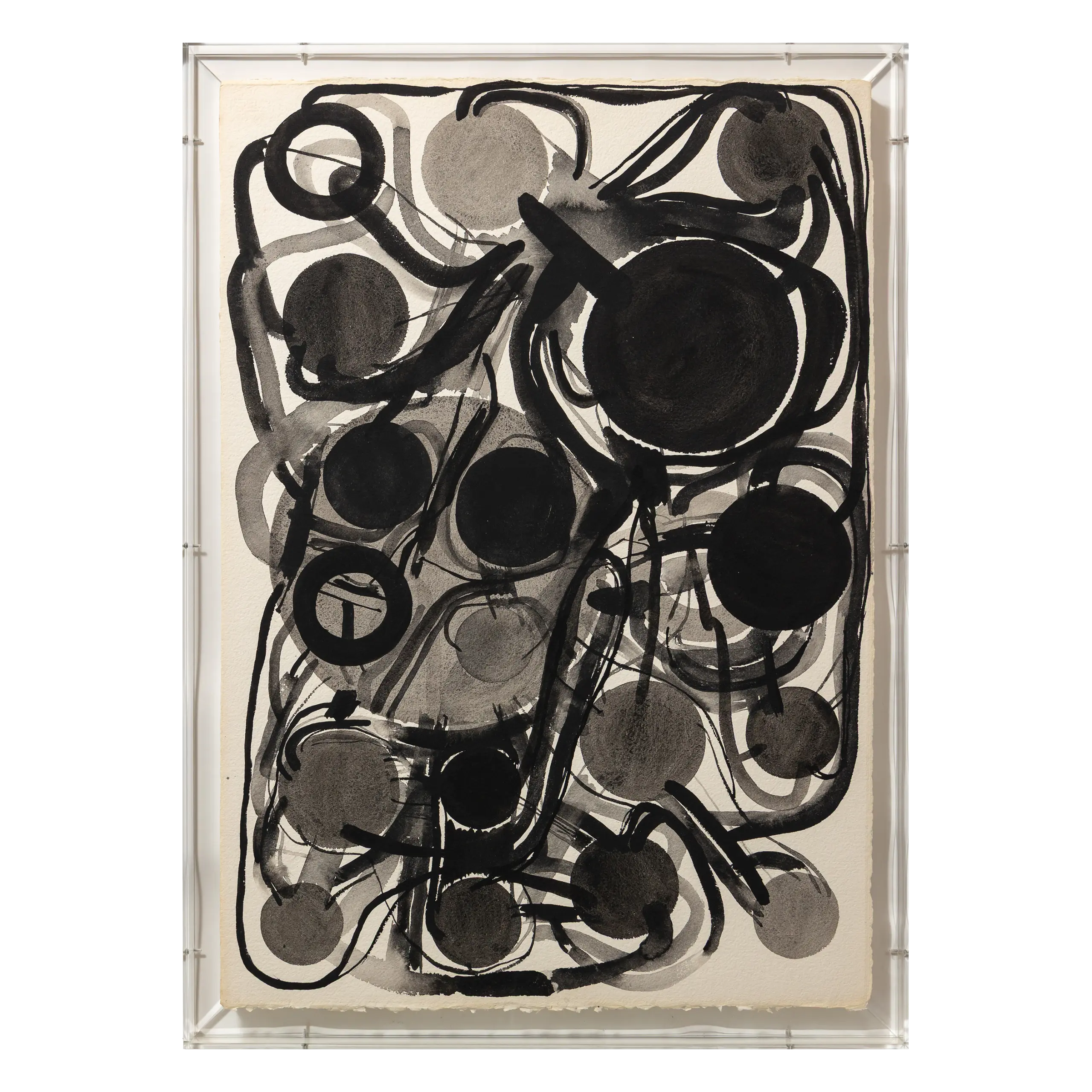
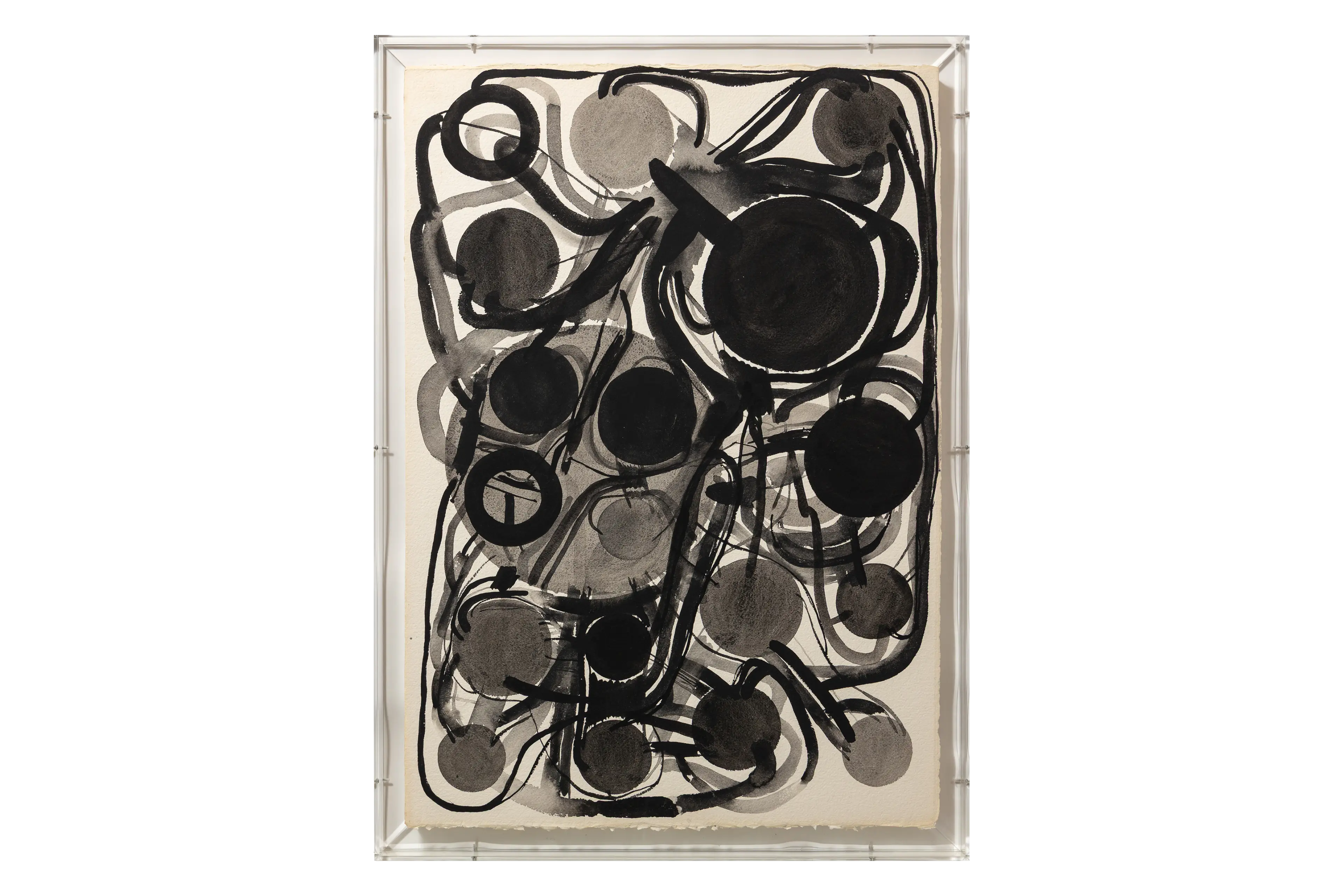
Atsuko TANAKA (1932–2005) was a member of the Gutai Art Association who brought immaterial elements such as sound, light, and electricity into her work. Born in Osaka, she studied at Kyoto City University of the Arts and then built a foundation in practice at the Art Research Institute affiliated with the Osaka Municipal Museum of Art, together with Akira KANAYAMA, Kazuo SHIRAGA, and others. At Kanayama's suggestion she moved toward abstraction, showed work in exhibitions of the Gendai Bijutsu Kondankai (Genbi) before joining Gutai in 1955, and in that same year entered the Gutai Art Association, fully engaging with the avant-garde led by Jiro YOSHIHARA.
At the 1st Gutai Art Exhibition that year, she presented "Work (Bells)," in which twenty bells ring in sequence. At the 2nd Gutai Art Exhibition in 1956 she unveiled "Electric Dress," combining colored bulbs and incandescent lamps, and at the 1957 exhibition "Gutai Art on Stage" she performed by wearing the piece. Working across collage, installation, and performance, she projected sensations of time and flickering light onto the picture plane and into space, a approach that stood out even within Gutai. After leaving the association in 1965, she continued to work chiefly in paintings that combine circles and lines.
From the 1960s onward her work was introduced in Europe and the United States. In 1986 major pieces were shown in Paris at the Centre Pompidou's exhibition "Japanese Art After 1945: Screaming Against the Sky" (also circulated under titles such as avant-garde Japanese art, 1910–1970). In 2001 the Ashiya City Museum of Art and History and the Shizuoka Prefectural Museum of Art hosted her first retrospectives, and in 2007 a focused presentation of her work was held at Documenta 12 in Kassel after her death. In 2011 the Museum of Contemporary Art, Tokyo presented "Atsuko Tanaka — The Art of Connecting," surveying her trajectory from the Gutai period through her late planar work. As an artist whose practice links Gutai to later international reassessment, her work is held in museums in Japan and abroad.
As people change over the years, works also develop shifts and changes with age. The works offered at Untitled range from comparatively recent pieces of about twenty years to older works that have passed through nearly seventy years.
Small scratches, changes in the paint surface, shifts in paper or support—these are not mere deterioration but traces of the time the work has lived through.
We do not value only perfect condition. We hope you will receive each work as a single existence, together with the time it has accumulated.
Accessories
Whether a work is framed is noted on each work page. Frame condition varies by work; please contact us in advance if you would like details.
We also accept custom framing matched to the work. As each piece is made individually for the space and work, delivery takes approximately two months.
Framed works include a storage box. Depending on the work, a new box may be made after purchase, which may take several weeks.