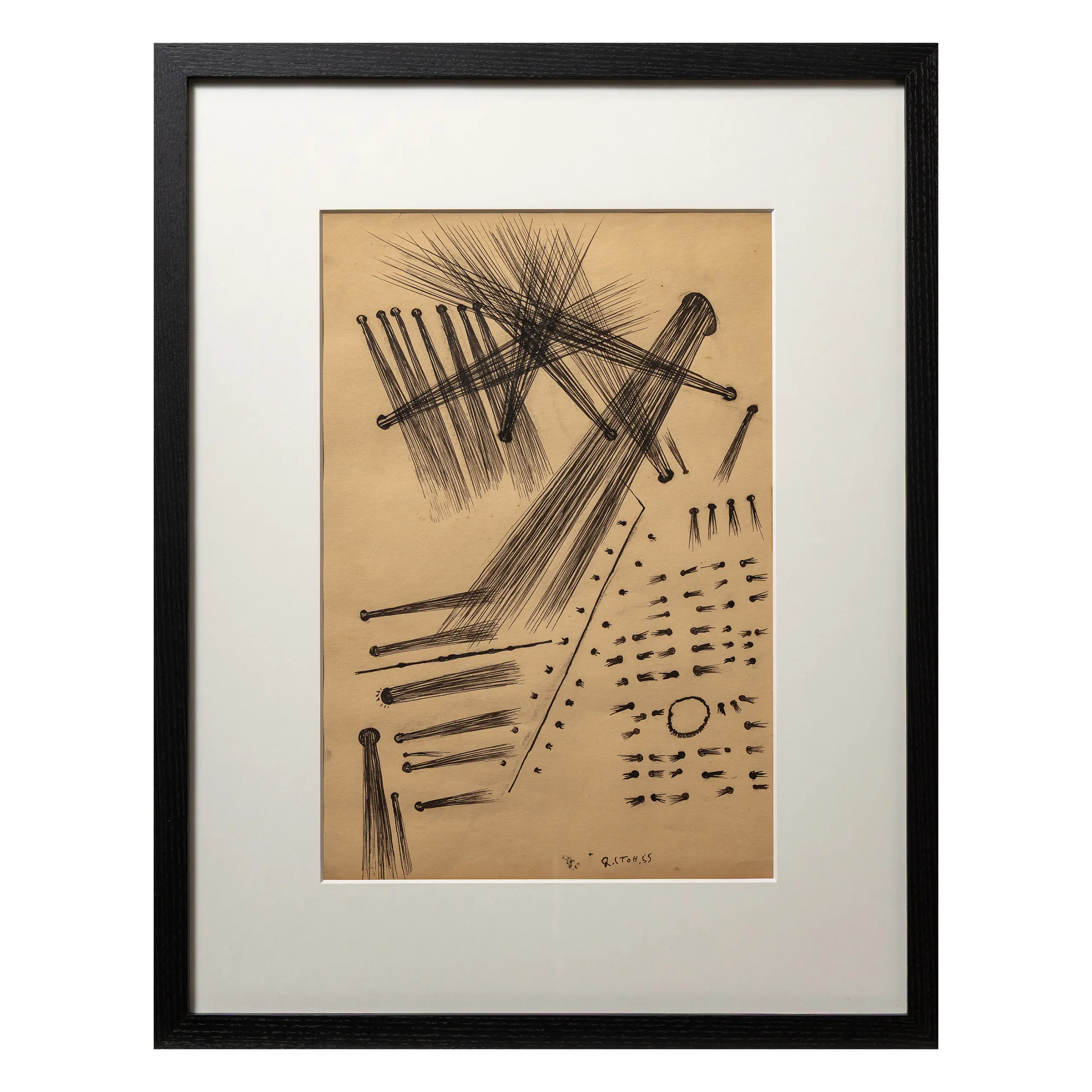
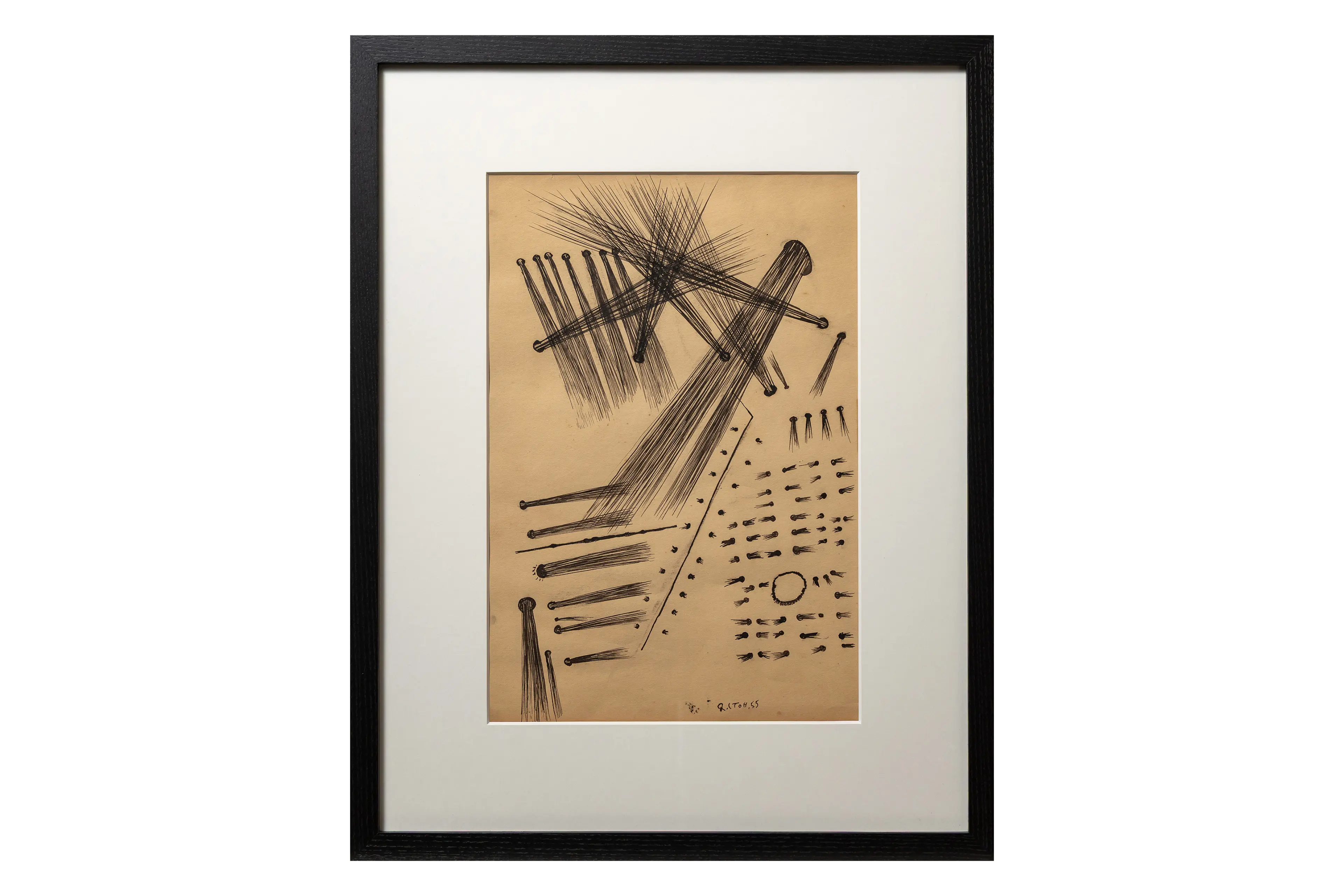
Ito Kyuzaburo was born in Shimogyo Ward, Kyoto, and trained in Japanese painting at the Kyoto Municipal School of Painting (now Kyoto City University of Arts). After graduating, he moved to Tokyo and turned his attention to Western-style oil painting, honing his skills at the 1930 Association Western Painting Research Institute. Before the war, he rose to prominence as a member of the avant-garde "Kyushitsu-kai" group, exhibiting primarily at the Nika Exhibition. In the post-war period, he returned to his roots in Kyoto, becoming a prolific member of the Action Art Association and a pioneer of the abstract movement within the Kyoto art scene.
While grounded in traditional Japanese techniques, Ito uniquely assimilated Western Surrealism, steadfastly pursuing a vision of "avant-garde art by Japanese hands" throughout his career. His works are characterised by a "translucent ephemerality," achieved by incorporating the subdued lustre and distinctive textures of Japanese painting into the medium of oil. This resulted in compositions of striking clarity. His pre-war style was heavily influenced by Surrealism, featuring motifs such as hats and pendulums; however, with the onset of the war, his worldview shifted, revealing a palpable sense of desolation beneath seemingly calm, bright colours. Following the war, he gradually simplified his forms, evolving towards a unique abstract style that emphasised colour and rhythm.
Ito’s achievement of "lyrical abstraction" represents a rare instance of an artist transcending Western imitation to reconstruct a personal artistic language. Yet, because he maintained a degree of distance from mainstream art circles to pursue his own path, he was often overshadowed by more dominant movements of the era, such as Gutai. As a result, he remains a distinctly solitary figure in art history.
As people change over the years, works also develop shifts and changes with age. The works offered at Untitled range from comparatively recent pieces of about twenty years to older works that have passed through nearly seventy years.
Small scratches, changes in the paint surface, shifts in paper or support—these are not mere deterioration but traces of the time the work has lived through.
We do not value only perfect condition. We hope you will receive each work as a single existence, together with the time it has accumulated.
Accessories
Whether a work is framed is noted on each work page. Frame condition varies by work; please contact us in advance if you would like details.
We also accept custom framing matched to the work. As each piece is made individually for the space and work, delivery takes approximately two months.
Framed works include a storage box. Depending on the work, a new box may be made after purchase, which may take several weeks.